
Okarche man recalls service as Air Force medic in Vietnam
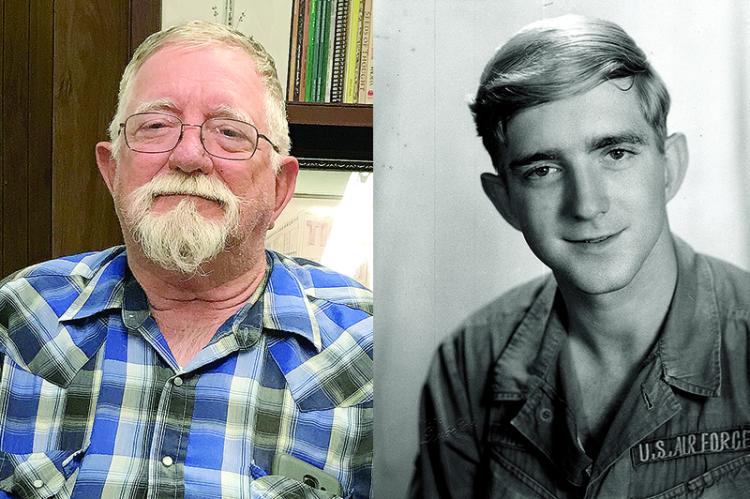
Occasionally an event will cause a return of old memories, some that might better be forgotten.
That happened to Robert Dougherty, 73, of Okarche recently when he dropped off a news release at the Times & Free Press Office about the Pleiku (Vietnam) Air Base Association, of which he is a member.
During the visit memories of his Air Force Service bubbled to the surface.
Dougherty joined the Air Force as a 5’-7”, 145-pound 19-year-old, about a year after graduating from high school and attending a year of vocational-technical training.
He was sort of at loose ends, he recalls, and joined the Air Force because he thought that would give him a chance to have some input into what he would be doing.
Besides that, the recruiter told him that he had a slot he thought he would fit right into.
He served for about five and onehalf years but not in the slot the recruiter had suggested he might. He became a sharpshooter and backup medic when he got to Vietnam.
A self-confessed “Mama’s Boy” as a youngster, he often counted on his mother to get him out of trouble.
But that all changed when he entered the military. He learned quickly that Mother had no influence with the Air Force.
“I had to learn to clean up my own messes and to follow orders,” he recalls.
Dougherty moved with his parents, Nolan and Delores Dougherty, and other family members to Okarche from Michigan when he was 5 and 1/2 years old.
He became so attached to Okarche that’s where he returned when he completed military service.
He worked for a number of industries and businesses in the Okarche and Oklahoma City area, including Temtrol and Home Depot.
He and his wife (and “best friend”), Patsy, lived in Okarche all 38 years of their married life. He lost her to leukemia three years ago.
He met Patsy, who lived at Elk City at the time, through mutual friends, who told him Patsy liked to hunt and fish, his favorite pastimes.
Patsy brought two sons, Kelly and Mark, to the marriage and Dougherty brought one, Chad. They all called him Dad.
Kelly lives at Bridge Creek and Mark at Purcell while Chad is deceased. He died at age 24.
Dougherty continues to live in Okarche where he spends much of his time in his garden. He has always had a garden wherever he lived, including time in the Air Force.
Dougherty’s father served in the U.S. Army during World War II and in Korea and gave him lots of advice on “do’s” and “don’ts” for service in Asia.
He followed some of it.
Dougherty became a backup medic sort of by accident, helping the unit’s medic in treating wounded servicemen.
Dougherty knew that the most important thing was to stop bleeding as quickly as possible.
When the medic asked him where he got his medical training, Dougherty told him FFA.
“Where’s that?” the medic asked.
Future Farmers of America – working on livestock projects, Dougherty explained.
He still carried on his responsibilities as medic after it became known that FFA wasn’t a medical school but a vocational program he participated in at Okarche High School.
He said he also learned a lot of useful information, such as the circulatory system, from his high school biology teacher, Mrs. Walta (Lucille), who also taught home economics to the girls.
Dougherty joined the Black Hawk paramilitary unit after finishing his Air Force enlistment.
That marked his most dangerous time in Vietnam.
While carrying out military missions, the unit would have been disavowed if anything had gone wrong.
He said he never let his mother know where he was in Vietnam because he knew she would be watching casualty reports and would become concerned if a report came from his activity area.
His Black Hawk unit’s primary mission was to clear areas of the Viet Cong who hid out among the friendly Vietnamese in villages, burning safe houses and blowing up tunnels where the VC hid.
The Black Hawk equipment was subject to sabotage by enemy elements, including stuffing paper in gas tanks, which would eventually disable vehicles – often at the most critical time – and planting venomous snakes (there are 37 different kinds in Vietnam) in their equipment.
Dougherty recalls seeing a tiny movement in a piece of equipment they were preparing to use and insisted they take it apart before putting it to use.
An extremely venomous green pit viper was eventually located and removed.
Such events required his unit to maintain constant vigilance.
“We stayed alive by staying alert,” he said.
Although assigned to the Pleiku Air Base but seldom there, (Pleiku is a town located near the Laos-Cambodia border) he became a member of the Pleiku Air Base Association when he ran across its existence on the Internet.
He won’t be going to the group’s 2020 reunion because it has been cancelled due to the COVID-19 pandemic.
However, he would still like to find other veterans who qualify for membership.
Dougherty served in the 362nd Tactical Electronic Squadron.
He was among the American servicemen who were castigated by antiwar protesters when they returned home, often being spit upon and called “baby killers.”
Dougherty remembers telling one protester who threatened to spit on him that he (Dougherty) would end it.
He had grown beyond his 5’-7” military entry size and had been introduced to more physical violence by then than most of the protesters would ever see.
Although the protesting class vilified the returning American troops, Dougherty said he and the other American servicemen who went to Vietnam felt they were there to help those people create a democratic form of government.
It didn’t work out that way.
The war ended in 1975, several years after Dougherty had returned home, the result of a hostile Congress looking for an exit and a president, Richard Nixon – who was advised by Secretary of State Henry Kissinger – looking for a face-saving exit.
Nixon signed a peace agreement with North Vietnam that required withdrawal of U.S. forces in 1973.
President Lyndon Baines Johnson, who served during a particularly volatile period of warfare, declined to seek re-election in 1968 due to opposition to the Vietnam struggle.
The long-running war, which had been under way in some form as far back as 1954, was continued by President Kennedy in 1961 under the “Domino Theory,” which held that if one Southeast Asian country fell to communism, many others would follow.
Communist forces ended the Vietnamese war by seizing control of South Vietnam in 1975, and the country was unified under the communist regime as the Socialist Republic of Vietnam the following year.
Dougherty considers the war a money-making endeavor for highly-connected American politicians.
He said his military service ended due to an Agent Orange condition. (Agent Orange is a chemical used by the American military to clear the Vietnamese jungle to facilitate U.S. military operations and created many health issues for American personnel who served there.)
Dougherty is of the opinion the U.S. could have won the war, which seemingly was always waged not to lose rather than to win.
He recently received a newsletter from J.D. Smith, president of the Pleiku Air Base Association announcing that the 2020 reunion has been canceled since so many members are in the high-risk age group for COVID-19 and it has been rescheduled for Sept. 12-15, 2021 at Harrisburg, Pa.
The 2022 reunion has been tentatively scheduled in Dover, Del.
Dougherty says most of the reunions are held in the Northeast.
The president’s newsletter states that the association currently has 139 members and asked members to put out the word to attract potential new members.
The letter also asked anyone having photographs or videos for the association’s website (www.pleikuab. com) to submit them to Michael Mullins, vice-president, at mgmullins42@gmail.com.
A second sheet accompanying the newsletter announced Veterans Administration benefits services
available to members’ widows and instructions on how to obtain them.
The newsletter also announced that two members of the association had died since the last newsletter.
Dougherty said those interested in the association may contact his email, redougherty10@gmail.com.