
Problem Solved
After 20years, Okarche on verge of quality drinking water
Okarche is a town on the move.
The end is in sight for its latest major improvement – a nearly two-decade-long effort to get nitrate-free drinking water.
Okarche has been working on the project since 2003 when it received its first Oklahoma Department of Environmental Quality consent order for having a water supply that hovered slightly above DEQ’s maximum concentration level (MCL) for nitrates.
That was the time that new national standards went into effect setting the allowable limit at 10 parts per million (ppm), down from the previous MCL of 15 ppm.
Okarche First in State
Okarche officials have been working on the solution ever since.
“Upon successful completion, Okarche will move forward as the first municipality in the state to permit a biological nitrate removal system for drinking water,” Town Administrator Richard Raupe said.
Aside from the nitrates, the town water wells, located 13 mlles west of municipal limits, produce high quality water that meet all other safe drinking standards.
Raupe, who served as a town trustee and mayor for some 25 years before taking the administrative role, began attending meetings with DEQ immediately after the first consent order went into effect and continues to do so to this time.
“I’ve learned a lot about water,” he says.
Okarche received numerous stays from DEQ on enforcing its consent decree, which would have cost thousands of dollars in penalties if enforced.
“They’ve been patient with us,” Raupe said.
If Okarche had been forced to immediately implement new programs to handle the nitrate problem, it would have created huge financial problems, Raupe observed.
Patience has worked to the advantage of both Okarche and DEQ.
Okarche residents will have safer drinking water and DEQ will have a successful model for other municipalities to follow.
DEQ is deeply involved in the Okarche project as a pilot program for other state municipalities having the same problem.
Nitrate reduction programs, including reverse osmosis and ion exchange processes, were very expensive during the early times after Okarche was first written up for nitrate content.
Cost has come down with the development of new technology.
Treatment System Unique
Biological nitrate removal is a unique water treatment alternative.
It was created by a Japanese scientist who won a Nobel Prize for his work, Raupe said.
While the program is new to Oklahoma, it has been implemented in some other states with similar problems as well as in Australia and New Zealand.
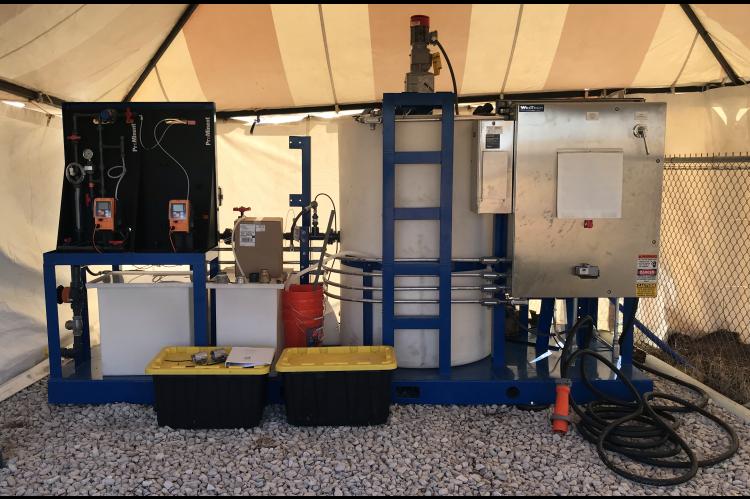
The treatment system being installed for Okarche converts the nitrates in the water into harmless nitrogen gas instead of concentrating it into a waste stream.
(The air all living creatures on earth breathe is composed of 78.08 percent nitrogen and 20.95 percent oxygen, small amounts of argon, carbon dioxide, neon, helium and hydrogen.)
Work on the Okarche system began Jan. 13 with installation of a treatment unit at the Okarche well site.
Besides the Town of Okarche, other participants in the program include a Little Rock-based engineering firm called Garver, and two technical companies, WesTech and AdEdge Water Technologies.
Raupe said significant financial and logistical challenges were associated with the first systems considered, including by-product disposal.
The water coming from the new evaporation pond is pure enough to run down a roadside ditch without causing damage in case of a heavy rain, an important consideration for DEQ approval.
While a test treatment system has been put in place, the construction start has not been without its problems, primarily due to Oklahoma weather.
A protective tent was placed around the treatment tank at the well site but high winds came up and virtually destroyed the tent, causing consternation by the technical team installing the system. However, a new cover has since been installed.
Okarche is Debt Free
An added bonus for Okarche because of the long planning process has been its ability to save up money to pay for the new system.
Raupe said Okarche currently has $5 million saved to pay for it.
Raupe said initial lab testing of water released by the treatment tank tested at 3 PPM (for nitrates) but has now been reduced to the point it is not discernible.
Additional testing and study are required by DEQ before it gives its stamp of approval to the system. A 30-acre evaporation lagoon, which would have been required as part of the system using one of the earlier programs studied, is not required under the biological nitrate treatment program Okarche has accepted.
“That’s a major money saver right there,” Raupe said.
Raupe also pointed out that cities and towns receive none of the ad valorem (property) tax that has grown due to the area’s booming oilfield, benefitting schools and counties, making the debt-free status of Okarche even more remarkable.
Okarche’s town government is financed by water sales and sales-use tax.
Okarche will be required to pipe the treated water from the well site to town, serving customers along the route.
DEQ insists that Okarche build the plant bigger than necessary to serve its current 1,300 population in order to be prepared for anticipated future growth.
A building – probably made of steel – will be constructed at the well site to protect the system, although in some climates the system can set outside.
Land for the treatment system is under negotiation.
The engineer’s plan for the system budgets $30,000 for land but Raupe said that is likely underestimated.
It is estimated Okarche can have all its statistics to DEQ by April, but then DEQ will require some time to review all the details before giving its blessing.
The engineer’s estimate for the project cost is $1.5 million but that does not take into consideration local land prices or a pipeline to town.
The plant will be built on a modular basis so that additional units can be built as growth requires.
Because Okarche is debt free, having already paid off $1.18 million in Public Works Authority bonds voted in 1999 for improvements to the water system, including a water tower, a bigger line to major employer Temtrol and curbs and gutters for paved streets throughout town, the board of trustees foresees no need for an increase in water rates to pay for the system’ s construction or expansion.
(Ed. Note: Okarche paid off the 20-year bonds in only nine years.)
“I believe this is our solution; we can wrap it up as quickly as DEQ gives us approval,” Raupe said.
Because of all the required testing and studies, Raupe is hesitant to make a definite estimate when it will go on line.
“We believe this will be good for Okarche and the state,” Raupe said.
School Advancing, Too
The improved water system is another step up for Okarche, which recently built new school additions, including a basketball gym and performing arts center that can be used by new music programs, the school’s perennial state champion speech and drama department and community events.
The new school construction also provides upgraded facilities for the vo-ag program and special education.
Supt. Rob Friesen of Okarche schools says he is hopeful that the new performing arts center and gym will be completed in time for graduation this spring.
“We’re not sure that will happen but it would be nice to have the air conditioning (the center will provide) available for graduation,” he said.
Okarche schools also have implemented the Science,Technology, Engineering and Math (STEM) program for students this year and moved into the new elementary building over the Thanksgiving vacation.
Friesen said boosts in property valuations (due in large measure to the area oil boom) have allowed Okarche to come off the state funding formula, which has provided greater flexibility in adding back programs for students.
Ryan Siebert is on the job as band director and is beginning the program in the elementary grades with the goal of growing it year by year.
Friesen said other improvements are in the works and will be announced in the future after details have been worked out.