
Progress marches on at Pioneer Telephone
From party lines to fiber optics
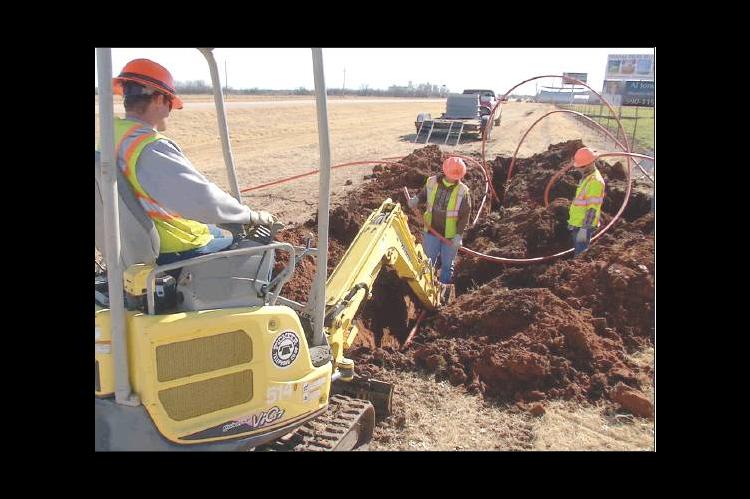
When Richard Ruhl began his career at Pioneer Telephone Cooperative 43 years ago, the Kingfisher-based corporation was in the midst of a major network overhaul.
“The cooperative was completing the upgrade of its copper network to one-party lines from four- and eight-party lines,” remembered Ruhl.
“I recall the reward and satisfaction we witnessed as employees from our customers, who were elated to have one-party service.”
Now in Ruhl’s 25th year as its general manager, the cooperative is in the midst of another major upgrade as it has tasked itself with replacing that copper with fiber.
From the most rural parts of its coverage area to the downtowns of places like Kingfisher and Newcastle, the cooperative is bringing gig service to all of its members and customers.
It’s all a part of the one constant in Pioneer’s world: Change is inevitable.
From landlines to pagers to cell phones. From copper to fiber. From dial-up to lightning-fast speeds.
Pioneer has seen change in nearly every aspect throughout its six-plus decades of service and kept its customers at the forefront of it all.
The conversion from copper to fiber is just one of the latest examples.
“I see the new vision of bringing fiber-optic broadband services to the cooperative members as another chapter in the company’s great history,” Ruhl said.
In an exclusive interview with the Times & Free Press, Ruhl discussed that conversion and all other things Pioneer.
During his tenure, Ruhl has been astonished time and again by the technological advancements and the company’s growth.
He has seen increases in data consumption and broadband demand surpass what he could have imagined for the company when taking over his position a quarter-century ago.
Meanwhile, net margins for the cooperative are at an all-time high.
This all-inclusive story touches on a number of Pioneer products, services and enhancements within the company. This includes the cooperative’s efforts to provide fiber-optics not only in rural areas through A-CAM, but also in towns by using Pioneer’s cash reserves.
Ruhl also shared a few details on a new product Pioneer has been keeping “close to the vest.”
The Age of Data
In just one year, data consumption by Pioneer Cellular customers has increased 300 percent.
“We are at an all-time record high,” said Ruhl.
Pioneer customers have used 15 petabytes, or 15 million gigabytes, of data in the past month, reflecting a pattern of growth that Pioneer has been seeing for the past few years, according to Ruhl.
“We see our biggest increase over the Christmas holidays. It happens every year. We have seen it for the past four or five years. We see this spike at the holiday time and we think it is coming back down in January, but it stays there,” he said.
“That is a lot of data.”
Fiscally Sound
Not only has there been an increase in data usage, but the company has seen an increase in its finances as well.
With $371 million in total assets for the last fiscal year, Pioneer is steadily approaching a half-billion-dollar corporation.
“Next year, I imagine it will be $400 million in assets, which is huge,” said Ruhl.
Additionally, the cooperative had historically high net margins for the year at over $34 million.
The historical high can be attributed to the federally-funded Alternative Connect America Fund Model (A-CAM).
Through A-CAM, Pioneer will receive more than $200 million over 10 years to build fiber-optic networks in rural areas.
Those funds accounted for about $24 million of the cooperative’s net margins.
“Every dollar that comes in we are spending to build fiber,” Ruhl said.
Ruhl explained that the expenses from A-CAM do not offset the revenue because it is depreciated over 20 years.
The Fiber of Our Lives
A-CAM is important for Pioneer, according to Ruhl, because the funds allow it to replace the 40-year-old copper network with a faster, more reliable fiber-optic network.
“Years ago, I heard an MIT professor, a very famous professor, Nicholas Negroponte, say ‘Everybody will want one gig to their desktop’ and this was in the mid 90s,” said Ruhl.
“I thought, ‘The guy is crazy. Everyone will want one gig to their desktop? What could you ever do with one gigabyte to your desktop?’ But, look at where we are today. We are doing one gig to the house.”
For Pioneer, that’s not always an easy task with so many of its customers in rural areas. However, the cooperative is well into the chore of making it a reality.
“People can get one gig service 14 miles out. That is amazing. Who would have ever imagined that was going to happen?” he said. “That’s what A-CAM does.”
Cities Need Fiber, Too
However, Pioneer also services larger, growing towns and cities.
“My concern was, it is great for people in the rural areas to have fiber, but what about the folks in town?,” Ruhl asked.
“We are going to have to do something about the people in town, so we started our own town overbuild and we are going to build all 76 towns in Pioneer’s service area with fiber.”
Currently, Pioneer is working on building the fiber networks in Newcastle and Blanchard, a nearly $52 million dollar investment.
Pioneer also plans on doing a complete overbuild in Hennessey then Kingfisher, followed by Crescent and Watonga.
Additionally, the cooperative has applied for the Re-Connect grant from the U.S. Department of Agriculture, which will cover the cost to build fiber in rural areas too expensive for A-CAM to cover.
Taking Care of Members
This past year, Pioneer was also able to give out almost $11 million in patronage disbursements.
Member equity at Pioneer is 77 percent.
“If you have service with Pioneer, your equity, or your ownership, is $288 million,” said Ruhl.
He added that it is almost unheard of for a company to be able to build out tens of millions of dollars of fiber from A-CAM, tens of millions of dollars in fiber overbuild from their own cash reserves and to give out a patronage distribution of that size at the same time without taking on any debt.
“Most generally, a company of this size is owned by the bank; they have a lot of debt,” Ruhl said.
Keeping It Local
These investments in Pioneer’s exchanges and members are a part of the company’s focus on being “Local. Loyal.”
Ruhl added, “We are local people. We are trustworthy people and we are just everyday people here to provide service to our customers and the difference in what we try to do is to distinguish ourselves from the competitors.”
He explained that Pioneer tries to differentiate itself by making more relevant contact with its members.
Not only do members seem to notice the difference, but employees as well, according to Ruhl.
Taking Care of Employees
Many of Pioneer’s 570 employees work there for their entire careers.
“It’s just a great company to work for. I think that not only the board, but the executive management team and all of the employees work together for a common good, to serve the customers. We are not out to satisfy the stockholders. We are not out to satisfy a private owner. We are out to satisfy the people that we serve, so there is a sense of gratification to that,” said Ruhl.
“There may be 570 employees, but everyone has somewhat of a family atmosphere. People really care about each other, so that makes a big difference as well. They are passionate.”
Ruhl also bragged on his current management team, which consists of David Post, vice president of human resources and legal; Jerry Kadavy, vice president of network operations; Kim Grellner, vice president of marketing, sales and service, and Jim Eaton, vice president of finance and administration.
“They are very engaged. It is probably the most engaged executive team that I have ever worked with and I have been in this position for 25 years,” Ruhl said. “It is an excellent group and we have an open dialogue and it’s an honest dialogue. We just all get along and we have very creative forethinking ideas.”
Any reduction in employee numbers is from attrition, according to Ruhl.
Investing in Future Workforce
As a result, the company invests a lot in higher education and youth in hopes of recruiting future employees.
Since 1991, Pioneer has given out $987,927 in scholarships, focusing primarily on STEM curriculum and education.
It also has internships available and is doing outreach through social media, traditional outlets and community activities.
Pioneer has also invested in branding at universities such as Southwestern Oklahoma State University in Weatherford and Northwestern Oklahoma State University in Alva.
This year marks the fifth year that Pioneer has been the premier corporate sponsor behind SWOSU with naming rights to its event center.
The Pioneer Cellular Event Center has gained the company a lot of exposure, said Ruhl.
“We made a significant capital investment, built a new business office in Weatherford, a new retail center. It is right there on Route 66, downtown. That was a big investment because it is a brand new building. It is a beautiful facility,” he said. “Branding with the university was just a part of that process.”
The Entire Pioneer Experience
The company is in the midst of many other projects that will enable it to continue serving its members.
In addition to changes in broadband, the company has also made updates to its cellular network.
Over the past two to three years, Pioneer has been building its own long-term evolution (LTE) core network.
The core is complete and Pioneer has transitioned 65 percent of its customers from the old LRA network to the new 4G LTE core that is compatible with the Verizon network.
Pioneer is also doing extensive testing on Voice Over LTE (VOLTE) on both the Pioneer core and LRA networks, said Ruhl.
VOLTE will allow customers to experience high definition voice on calls and will also free up 3G spectrum for Pioneer that can be used for data applications.
Pioneer’s number of cellular customers surpassed the number of landline customers several years ago.
“I would have never thought that would happen. The reason is because people have their cell phone that is replacing landline,” said Ruhl. “So, they look at it and they say, ‘Well, I’ve got to change and go to broadband’ and that is a good thing because wireless cannot, at least today, provide one gig like fiber can.”
Within the past year, Pioneer has also seen the number of broadband lines transcend the telephone lines.
Pioneer customers can also look forward to a change in Pioneer television.
“We are rolling out a new video product in the very near future,” said Ruhl. “It is called iVideo. We are keeping it a little close to the vest right now, but it is a video streaming service, much like Netflix.”
He added that what will set Pioneer iVideo apart from other streaming services is that customers will still have access to local channels.
Pioneer is beginning employee trials on the new product this summer.
Changes have also been made to security at Pioneer.
The corporation has joined the global initiative, Mutually Agreed Norms for Routing Security (MANRS) which is supported by the Internet Society.
In order to become compliant with the initiative, Pioneer has had to make some policy changes.
In addition to tightening up policies and procedures to ensure information security, Pioneer has also hired an information security officer.
“We brought him in so the information, customer information, can remain secure, confidential and locked down at all times and so our policies and procedures remain information security compliant,” said Ruhl. “We want to be compliant because we handle a lot of customer information and it needs to be secure and it needs to be confidential.”
There have also been alterations in the security systems available to customers.
“They’ve made enhancements to what they call ‘access control,’” explained Ruhl. “That is where you use the fob to get in and it is getting to be more and more commonplace for businesses to want access control. Access control and the CCTV, the video, have become a really big deal. It seems like everybody wants cameras.”
Pioneer is also in the process of making the largest back office change it has ever undertaken, according to Ruhl.
It is implementing a new billing system, replacing its
operations. [Photo provided]
current internal platform that was created in the 90s.
“The enhancements for customers, both online and point of sale in retail centers, are extraordinary,” said Ruhl. “We believe we are going to take the customer experience to a whole new level.”
The Future of Pioneer
As for the cooperative as a whole, Ruhl says he is optimistic.
“The cooperative is in very, very strong health financially,” said Ruhl. “It appears to be financially sound over the course of the next five years for sure and hopefully beyond that point.”
While it’s difficult - and almost impossible - to predict the long-term future of the industry, Pioneer still strives to prepare itself for what lies ahead through planning.
“Our five- and 10-year strategic plan for Pioneer Cellular is filled with significant challenges, both economically and operationally,” Ruhl said. “But our vision is to continue to expand and enhance our wireless business.”
This goal includes plans to provide LTE High definition Voice over IP (VoIP), and Voice over WiFi (VoWiFi) capability as well as faster 4G and 5G services.
Ruhl added that Pioneer plans to “continue to provide the high quality, reliable coverage, and local customer service our customers deserve in this hyper-competitive, capital intensive, continuously evolving business.”
Building out the fiber-optic network will remain the focus of the landline side of the business for the next decade.
“Our 12-year goal is to overbuild 95 percent of our existing copper lines with fiber-optic cable to the cooperative members located throughout western Oklahoma,” said Ruhl. “The life expectancy of fiber-optic cable is projected to be at 25 to 30 years, so this overbuild takes the cooperative ‘landline’ business and vision well into the future.”
The remaining 5 percent will be expensive and challenging due to how rural the locations are, according to Ruhl.
“The ‘Pioneer Go-Fiber’ project is a very aggressive, massive project, and will take 10-12 years for us to successfully complete, but will certainly lay the foundation for many decades into the future for the cooperative,” said Ruhl.
“I see the current future for the cooperative, and our affiliate companies, as a very challenging, but exciting and ultimately rewarding time to be in.”