
Providing support in state’s largest cities can leave Troop J even more short-handed, trooper tells Lions
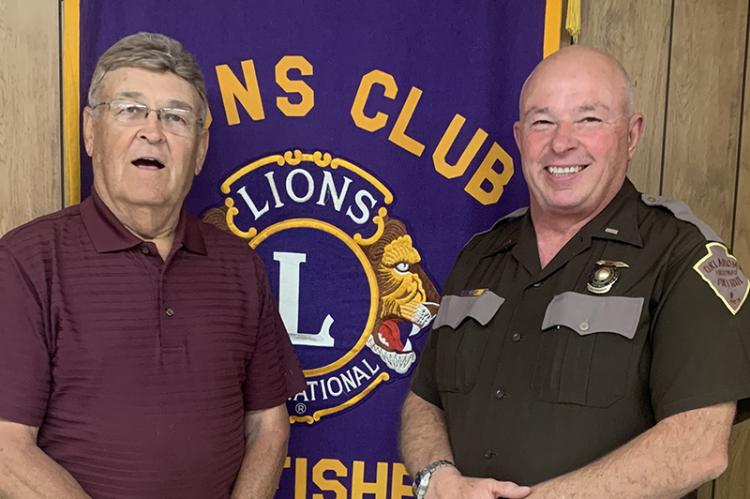
The moment Bill Reitz watched the video of George Floyd being killed, he knew it was wrong and he knew there would be consequences.
“It upset me what I saw,” Reitz told Kingfisher Lions Club members last Thursday.
“I was upset. I was mad.”
Reitz is a lieutenant with the Oklahoma Highway Patrol Troop J. He spoke to the civic club members during their weekly luncheon as the fallout continues from Floyd’s death on May 25.
Floyd, 46, was suspected of passing a counterfeit bill.
The resulting interaction with police found his neck trapped underneath the knee of Minneapolis (Minn.) police officer Derek Chauvin for several minutes.
In the video that’s been viewed millions of times, Floyd could be heard saying that he couldn’t breathe while also being handcuffed while face down.
Reitz said the videos he’s seen have shown the initial encounter between Floyd and police, which was cooperative, he said.
The next video begins with Floyd being handcuffed underneath Chauvin.
While Reitz said it’s unknown what happened in the unseen interval, there was one thing of which he’s certain: A handcuffed suspect, face down, shouldn’t have a knee on his neck, especially for an extended period of time.
“It was in violation of anything I’ve ever been taught as a police officer or anything (OHP Trooper) Mark (Williams) has ever been taught,” Reitz said, pointing to his colleague, who joined him at the meeting.
Chauvin and three other officers were immediately fired by the police force and have since been charged with various crimes relating to the incident.
Still, Reitz knew the protests, riots and looting would result in some areas of the country. He was surprised, he said, to learn they were making their way to Oklahoma City.
Protesters - some peaceful and some not - have gathered in Oklahoma City and Tulsa and some of their suburbs since last Thursday.
The protests have shut down parts of the interstates in both of the state’s largest cities.
The interstates fall under the OHP’s jurisdiction, even inside a city’s limits, Reitz said, and the agency was tasked with getting the highways back open.
Outside of that, Reitz said the OHP is a “support agency.”
The OHP’s help is requested alongside other agencies such as local police and sheriff’s departments.
That can - and has - put a strain on local resources.
Troop J, headquartered in Enid, covers Kingfisher, Blaine, Garfield, Grant, Major, Woods and Alfalfa counties.
Reitz said there are currently 20 troopers to cover the seven counties, down from a high of 28 at one time within the last three years.
Troop J has a pair of “strike teams” that consists of seven troopers each. Reitz said if both of those were called into action to help police the protests, that leaves six troopers to cover all of Troop J.
On top of that, one other trooper is a member of the OHP’s Emergency Response Team (ERT) and two others are members of its tactical team.
That brings the number down to three troopers and one lieutenant to take care of the seven counties “24 hours a day, seven days a week.”
“But we would do it,” Reitz said. “It wouldn’t be easy, but we would do it.”
Reitz added that its difficult to recruit to the OHP, especially in this climate.
Adding to that, there have been a number of recruits drop out of this year’s academy, leaving less than 70 potential future troopers in this year’s class.
“That’s barely putting a Band-aid on what we need,” he said.
Furthermore, Reitz said its unlikely an academy can be held next year, due largely to funding cuts.
“We’re already under-staffed and we’re going to see a lot of troopers retiring over the next couple of years,” Reitz said.