
Public Comment Revisited
School board adopts new policy to make citizen participation easier
KT&FP Managing Editor
After two months of discussion, the Kingfisher Board of Education has a new policy regarding citizens addressing it at meetings.
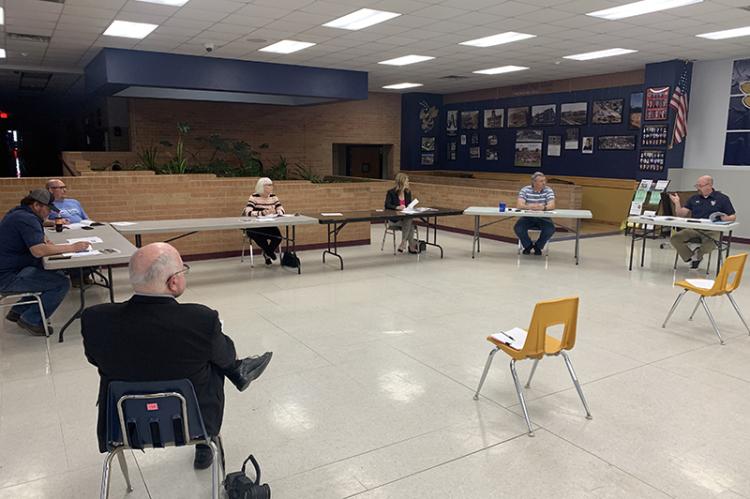
The policy was approved during Mondays regular meeting held at the high school cafeteria. The meeting began at the administration office, but members adjourned temporarily to move it to the larger space, allowing for proper social distancing.
Among the highlights of the new policy:
• Requests to address the board must be made at least 15 minutes prior to the meeting as opposed to five business days;
• No public comment is allowed at special meetings, only regular meetings;
• Individual addresses to the board will be limited to three minutes and a total of 20 minutes of each meeting will be allotted for the public comment portion;
• If the public comment is regarding an item on the agenda, board members will be allowed to interact with the speaker. If the subject matter isnt on the agenda, board members can only listen;
• Matters regarding personnel or student suspension cannot be addressed, but should instead follow the district’s chain of command or student suspension appeal policy.
“I think it’s a great starting point,” said Mike Copeland, board president. And if we see something down the road that needs to be changed, we can change the policy.”
Superintendent Jason Sternberger agreed.
“I think it’s better and more transparent for the public than the policy we currently have,” he said.
The policy in place before Monday’s action was adopted in October 2005.
Following is the new board policy in full:
All regular, special, and emergency meetings of the Kingfisher Board of Education shall be open to the public.
The board wishes to hear the viewpoints of citizens throughout the district and considers the responsible presentation of these viewpoints vital to the efficient operation of the school system. The board also recognizes its responsibility for the proper governance of the schools and the need to conduct its business in an orderly and efficient manner. The board, therefore, directs the superintendent to establish procedures providing for limited participation at school board meetings for the citizens of this district.
Citizens are encouraged to attend meetings of the Board of Education and are allowed to address the Board and to comment concerning the Boards’ deliberations or on other relevant issues of interest/ concern at regular meetings. Requests must be submitted at least 15 minutes prior to the start of the meeting. Each individual must sign verifying they have read the instructions regarding comments. Public comment will not be permitted at special meetings or emergency meetings of the Board of Education unless the meeting is declared to be a public hearing for that purpose.
The Board President may interrupt and terminate any presentation not deemed to be in accordance with the guidelines set out by this policy. The Board President may also, after a warning, preclude an individual speaker from addressing the Board on any other agenda item at that meeting and/or at the next regular meeting of the Board of Education for violation of the guidelines set out by this policy.
Issues related to personnel or student suspensions cannot be addressed during public participation as the appropriate due process must be afforded employees and students. These issues should follow the districts chain of command or student suspension appeal policy.
Should a member of the public wish to lodge a complaint or resolve a particular issue of concern, he or she may be directed to the district’s policy regarding complaint resolution procedures.
The individual dignity of board members, District employees, students and members of the public must be respected by all speakers. No Board members, employees, students, nor members of the public will be subjected to verbal abuse.
Each person requesting to address the board on agenda items or general comments will be allotted 3 minutes to speak. The public comment section of the agenda shall not exceed a total of twenty (20) minutes.
At the beginning of the meeting, the Board President shall inform the Board of the names of each person requesting to address the Board at that meeting and the agenda item(s) or public comments each person has requested to address. The Vice-President, or in his/her absence the Clerk, shall be responsible for keeping track of the time used by each speaker.
A citizen’s request to address the Board will not “carry over” to the next regular Board meeting. If all twenty minutes allotted for citizens’ comments are used before a citizen gets an opportunity to speak, that citizen must fill out a new request to address the Board at the next meeting. The Board will hear comments in the order in which the signed forms are received.
At the conclusion of a speaker’s remarks regarding items on the agenda (Form A), the board may choose to ask questions of a speaker or to dialogue with the speaker. Any time of Board interaction will not be counted toward a speakers time limit.
In light of the coronavirus pandemic, the board also adopted policy that allows it to meet via videoconference or teleconference if the necessary amount of members arent able to gather in one physical location, or if one or more members cannot attend.
The policy runs through Nov. 15 or until Gov. Kevin Stitt declares the current state of emergency to be terminated.
Since meeting dates have already been approved through that time, if it becomes necessary for the board to meet via video or telephone, the regular meeting will need to be canceled and a special meeting called.
The agenda can remain the same, said Sternberger, with one exception. There can be no new business at a special meeting.