
Saltwater source still not identified
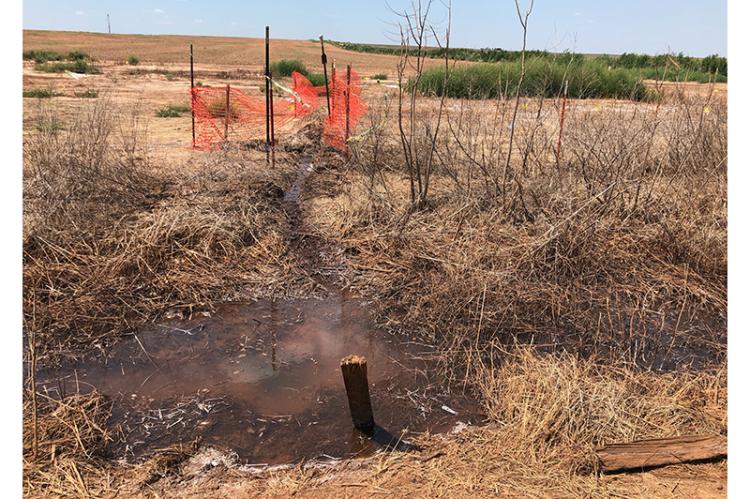
The source of a saltwater spring bubbling up on property northwest of Omega had not been identified at press time Friday, but an Oklahoma Corporation Commission spokesperson said an answer could be expected by late Friday afternoon.
The saltwater purge, so named because the water is coming up from underground as opposed to an aboveground spill, is percolating to the surface at the rate of 68 barrels a day, Matt Skinner of the OCC told the Times and Free Press on Thursday.
The OCC has dug a trench to route the water from the field where it is surfacing to the borrow ditch, where it is hauled away via truck.
Skinner said the location of the saltwater appears to be well below the water table and no data shows any drinking water contamination, but added “that’s a threat anytime you have saltwater coming to the surface, which is why it’s being contained and hauled away while we figure out where it’s coming from.”
The purge was reported by landowners July 1 after they first noticed trees dying along the roadside and then discovered a soft spot in the field during harvest.
The purge is located about 50 yards south of the intersection of NS Road 2690 and EW 800 and was inaccurately reported in Wednesday’s Times and Free Press to be a mile west of the Blaine County line.
However, Kingfisher County Commissioner Heath Dobrovolny pointed out that 2960 is actually the county line and the water is coming up about 20-30 feet west of the road.
Devon Energy voluntarily plugged in three vertical wells in closest proximity to the purge, but that had no impact on the volume of water coming to the surface, Skinner said.
Those wells were mistakenly reported as saltwater disposal wells in Wednesday’s paper.
Four other wells in the vicinity, operated by two other companies, also have been shut in to allow pressure and volume data to be collected for OCC analysis, Skinner said.
An outside consultant has been brought in and a pollution abatement director has been on scene on a daily basis, Skinner said.
“It’s a situation we take very seriously,” he said. “Our first concern, obviously, is to stop the flow.”
After that is accomplished, the next step is cleanup.
Skinner said if the impacted soil can’t be put back to its original state, it will be removed and replaced with soil of equal quality.
“Who pays for that depends on who we find is the responsible party,” he said.