
Sanders pleased with legacy he’s leaving as chapter ends
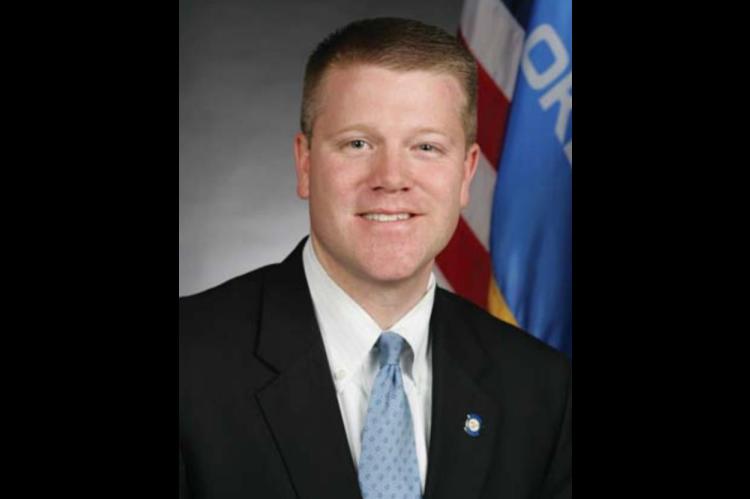
[Ed. note: The following article is the second of two about the political career of State Rep. Mike Sanders (R-Kingfisher) who is ending a 12-year stint in the House of Representatives as the longest-serving Republican in District 59.]
As his final months in office wind down, it’s unlikely that someone with State Rep. Mike Sanders’ decades of political savvy honed at the state and federal level would not already know his next moves.
But in a recent conversation with the Times & Free Press, the six-term legislator and current House majority leader only confirmed two certainties about his future plans: He’ll still be in public service and he won’t be a lobbyist.
So instead, our discussion centered on his experiences of the last 12 years in state government.
Sanders was no stranger to government operations when he arrived at the State Capitol as a freshman legislator in 2008. He’d worked for U.S. Congressman Frank Lucas, as director of interns in the Bush Whitehouse and then in the U.S. Department of Agriculture.
Even so, the state political process still held some surprises.
“Everything starts with the budget process – figuring out what we have to work with and then deciding the best way to appropriate it,” he said. “But how that process actually worked was shocking to me.
“I thought we would get all the info we needed from state agencies who would come willingly with their books open.
“I thought we appropriated all the money spent but we only appropriate about $7 billion of about $25 billion spent.
“The rest comes from other sources, including federal funds paid directly to agencies – information that by law, we couldn’t get.”
Sanders said some agencies were transparent about all their revenue streams and how that money was allocated but others were not.
“We can see all that information now because we have set up the Office of Fiscal Accountability and now know about every federal penny that comes in, but when I started, legislators were not entitled to that information, by law,” he said.
“Just about the time you get a real good handle on how all that works, you’re term-limited out.”
No Buyer’s Remorse
From Sanders’ first day on the House floor, he’s applied the same standard before voting on any piece of legislation, he said.
“These are three questions I ask before every vote on every piece of legislation: Is it good for my district? Is it good for the state? And does it violate my faith?” he said. “If it passes those three tests, I’ll vote for it.”
Apparently, that three pronged test has stood Sanders in good stead. Out of what he estimates as more than 60,000 votes he’s cast over the past 12 years on the House floor, “there’s probably about five bills that I can think of that I would have changed my vote on later.”
“It’s important to me to make decisions that I can be proud of and I feel like I’ve done that” Sanders said. “I’m able to sleep at night. I still have my hair and it hasn’t gone white.”
Legislative Highlights
One of the pieces of legislation he is most proud of shepherding through the sausage-making machine is actually the first one he ever submitted and very nearly the last one he actually got passed.
“The first bill I ever filed was to make the Oklahoma American Legion tax exempt,” he said. “I didn’t think it would be that difficult but I had to run it seven times and it took me 11 years to finally get it passed.”
Sanders said the American Legion was the only one of the state’s organizations for retired military that did not have a sales tax exemption and it just made sense to him, but apparently his colleagues needed some persuading.
“I was bound and determined to do it and I finally did,” he said.
Another highlight for Sanders was his legislation rewriting state laws on prosecuting driving under the influence cases.
His legislation clarified that all DUI charges had to be filed in district court rather than municipal court and was prompted by an incident when a car driven by his wife Nellie was rear-ended by a drunk driver who still had his license even after six other DUI charges that same year, all filed in different municipal jurisdictions.
The problem, Sanders discovered, is that only Oklahoma City and Tulsa municipal court are “courts of record” so that convictions in those cities go on a driver’s permanent record.
Other municipal convictions were going unnoticed when a driver is arrested again in a different municipality.
“That legislation was not popular in certain cities where municipal courts were making a lot of money off of DUI prosecutions, but centralizing that process means those chronic offenders won’t slip through the cracks and our roadways are safer,” he said.
Sanders also is proud of legislation he spearheaded to make sex offense laws stricter for sexual predators.
And his most recent project has been to provide teachers with more tools to identify and educate students suffering from dyslexia.
He authored a bill last year to train teachers to recognize the signs of dyslexia and added another bill this year to provide for screening.
“Teacher training will begin this year with in-service classes but the screening bill will be a game-changer for the state’s reading scores.
“I promise when you compare classes before and after this, you will see an increase in reading skills and reduction on other negative impacts like dropout rates.”
Sanders said the idea that his legislative career is over is “still a little surreal.”
“Getting sent home for most of this session by the pandemic has weirdly helped me come to grips with it a little better,” he said.
As much as he’s enjoyed this chapter of his career, “there’s always an end and a new beginning, and I’m looking forward to whatever the next chapter may bring,” he said.
And no, before you ask, he’s still not ready to say exactly what that next step might be.