
Scrambling for Solutions
Local DHS office closing soon; social workers, ADA seek alternatives
Nowhere to go and not much time to get there.
As contradictory as the statement may sound, that’s essentially what the staff of Kingfisher County Department of Human Services is facing.
The DHS staff has to be out of the office it leases on the south end of Kingfisher by June 19.
It’s not due to a dispute with the building’s owner, rather a mandate from Oklahoma Department of Human Services, which announced late last month that it was closing offices in 34 counties.
Kingfisher - along with Blaine and Logan counties - was among those to be closed.
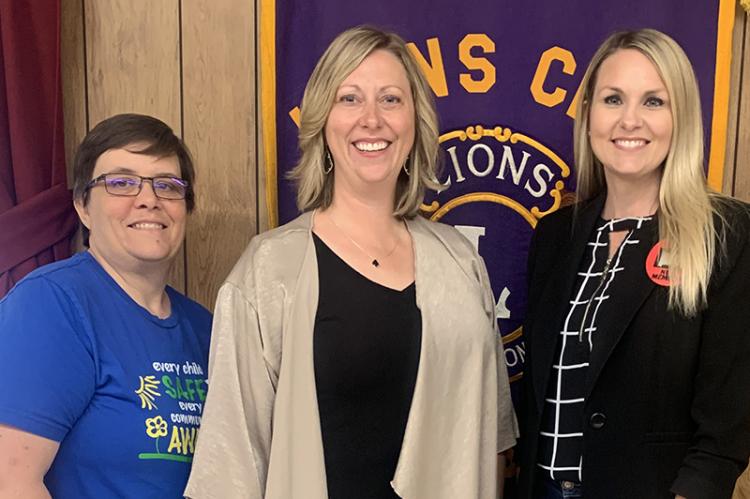
“I found out on May 27 and they have to be out by June 19,” said Assistant District Attorney Molly Neuman in an address Thursday to the Kingfisher Lions Club.
Neuman was the guest speaker along with Debbie Osborn, a child welfare specialist.
“They are scrambling right now,” Neuman said.
While services for children are a bulk of the work for DHS, the actual amount of services provided is extensive.
Staff help with Supplemental Nutrition Assistance Program, Sooner-Care (Medicaid), Temporary Assistance for Needy Families, Low-Income Energy Assistance Program, WIC and several others.
Staff are directed by the state to provide the help out of offices in El Reno or Enid.
However, added Neuman, these are families “that often can’t afford the gas to get across town or can’t make it to court.”
The move by OKDHS is one to save money. Facing budget reductions, it’s a proactive measure that’s expected to save the agency about $6 million and not reduce staff.
Staff will be expected to provide services more via “teleworking,” a move implemented at the onset of COVID-19.
“Our agency has learned so much in light of COVID. We know that we can continue to serve our customers in a meaningful way while teleworking,” OKDHS Director Justin Brown said. “Many of our staff are already working from the field.”
In an email to the
While Osborn agreed that it’s easier to complete her paperwork at home, it’s a small portion of her job.
“That’s just a few hours,” she said. “The rest of the day, I’m needing a place to take the kids (under her care).”
And that’s the crux of Osborn’s problem locally.
The actual office space is where Osborn and other DHS employees take children after they come into their care.
“It’s always for at least three hours and it’s usually for eight to 10 hours,” Osborn noted.
She said these are children who are often hungry, dirty, crying and scared.
“They’re with a complete stranger,” she said.
Osborn and other staff feed the children with a kitchen that’s on site. They provide clean clothes, diapers, toys for them to play with and try to comfort them all while working through the process of trying to find them foster care.
“Now we have nowhere to take the kids,” Osborn said. “And where are we going to put all of that stuff?”
Neuman said the local agencies have not been notified whether OKDHS will provide money to even rent a storage unit.
So far, the state agency’s only guidance has been to “strengthen community partnerships.”
Neuman has begun reaching out to the community for help in the forseeable future. She said she’s got a meeting with the Kingfisher Ministerial Alliance this week, for instance.
However, she said, there are a ton of hurdles to clear. Many, she said, they know about. Others, she’s still not sure.
“There are a lot of concerns right now and no real answers,” she said.
Among the concerns is supervised visits between parents and children, which are the base of getting families reunited longterm, Osborn said.
In smaller communities like Kingfisher, confidentiality is tougher to achieve. Public settings for DHS-supervised visits are usually out of the question.
That’s another service the current office provides as it has a two-way mirror, which allows the staff to supervise without being in the room.
Neuman also said she expects reported cases of child neglect statewide to increase dramatically once school resumes.
The number of reported cases has been down since the pandemic shutdown, but Neuman and Osborn noted that it’s usually teachers, counselors, coaches and other adults who have day-to-day interaction with the children who make the reports to authorities.
It’s expected that school will resume with in-person instruction in the fall.
“There are going to be kids who have been neglected for seven months,” Neuman said. “My concern right now is that we’re just at the base of cases starting to pick back up. The cases are going to skyrocket.”
And, Neuman said, that puts added pressure on Osborn and others in her position.
“It puts so much on these workers,” Neuman said.
Osborn said the list of concerns is long with no office space to call home, but did note five needs, some more immediate than others:
• Visitation spaces;
• Storage space for clothes, blankets, diapers, toys and other items provided by DHS for children when they come into their care;
• Drop-off spots for the school supply drive the DHS annually holds;
• Drop-off spots for the Christmas gift drive;
• A space with a kitchen to provide food for the children and families.
The current office provides for all of that, but within a week it won’t be available.
“My hope is that we’re able to work with community partners,” Osborn said. “But we don’t have a lot of time.”