
Simunek wants endorsement to remodel library, build pavilion
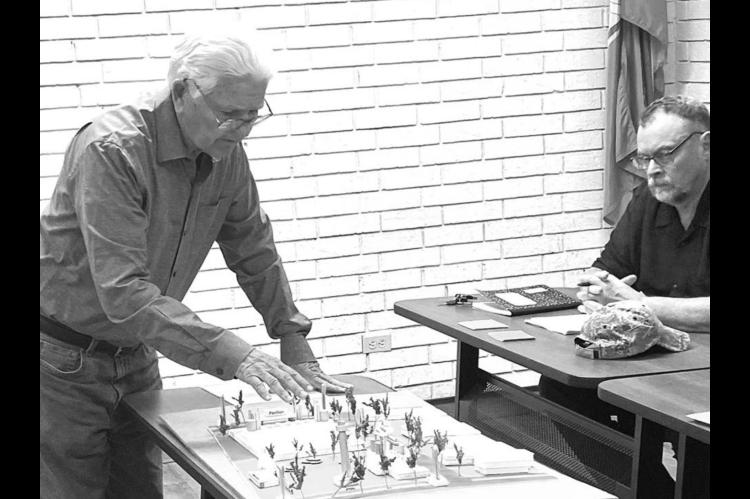
Hennessey Town Trustee Richard Simunek said he only wants the town board to “endorse” these two plans: (1) Expand, remodel and fireproof the old high school that now houses the public library and (2) Construction of a downtown year-round pavilion, plus a park and walkway that would be behind buildings on the west side of Main Street in the 200 block.
He explained those plans at last Thursday night’s town meeting under items he’d had placed on the agenda.
He told members he wouldn’t ask them to vote on those plans until the May 12 board meeting.
Simunek said a few months ago Mayor Bert Gritz had suggested he take on those projects himself instead of asking the town to do them.
“So that’s what I’m going to do,” he said.
“Why not just start on one of them?” asked Vice Mayor Clif Vogt, who chaired the April meeting in the absence of Gritz.
“I don’t want to just sit around anymore,” said Simunek, who’d proposed the library and pavilion projects in January 2020 after he’d been on the board about a year.
Simunek said he plans to offer HHS graduates and others the opportunity to work on both “legacy programs” with their contributions of money, time and energy to make them happen.
He and his late wife, Zorita, graduated from HHS in 1964. She died in 2012 and Simunek returned to his hometown the next year.
Since then he has restored two downtown properties on Hennessey’s Main Street. The Champlin Station is now the Champlin Apartments and the former Roberts Sinclair Gas Station is being readied for a museum.
$2 million library endowment
“A $2 million endowment has recently been pledged to maintain the physical facilities and operation costs at the library,” Simunek told the board, adding he is determined to get grants and legacy gifts to complete that work.
The 3,000 square-foot library is housed in a brick structure built in 1928 for a high school. From 1964-84 it served as the elementary school and was later acquired by the town when it was used as both a library and town hall.
“Our library is a fire trap,” added the local preservationist. “We need a schematic to see what can be done and the wiring must be replaced.”
Also, with the town board’s approval, they will use the historic library building, auditorium and old gym (stage in auditorium) as in-kind contributions from the town to get grants, he said.
Simunek referred to the library as a Sokol, and said the “founding principle of a Sokol was a sound mind in a sound body.”
He said Hennessey’s Sokol is physically composed of the old high school building (later used as an elementary school), its auditorium (now called the Ortman Auditorium) and gym (now the stage) and also includes a museum, archives and a war memorial.
War Memorial in library
Simunek struck a chord with many when he mentioned a large memorial in the history section of the library that lists 276 who died in World War II.
He said the ornate memorial listed all of the ones who went to high school in Hennessey, but said many Czech students didn’t go to high school.
Then he read parts from a letter that Dale Lee Berken-bile wrote to his mother July 23, 1944:
“You know, a funny thing happened this evening. As I sat near my fox hole, the Jerries sent around a dozen shells over in about 10 or 15 minutes and I counted eight duds that didn’t explode.
“Say mom, when you get home, I wish you would put some light weight oil on the wheels of my roller skates. I might be counting my chickens before they hatch, but if you don’t look forward to the future you would go nuts.”
Dale Berkenbile died three days after he wrote that letter and had turned 21 the month before. He was killed 22 days after landing in Normandy from injuries sustained by incoming German artillery at St. Lo, France, as the allies were trying to break out of Normandy.
Simunek ended his request to the town board by saying: “If the Hennessey Sokol is destroyed, the compelling story and history of Hennessey is destroyed. America’s and Hennessey’s great story will be taken to the town dump.” Lacy did it, and we can too
Lacy did it, and we can too
Simunek recalled when Hennessey Public Schools learned they owned a former Lacy Public School structure (once a cafeteria) that was collapsing and decided in 2014 to destroy it.
Then, some Lacy people got together, hired a lawyer, got the old school property back and restored it, he said.
“Now there are more than 20 people who enjoy having dinner and playing cards there every two weeks,” he said.
“It’s the same thing with our library and I know there are people out there who don’t want it to be destroyed. It can be preserved.”
Library history
The library is housed in the brick structure built in 1928 for a high school.
From 1964-84 it served as the elementary school and was purchased by the town in March 1983 for $150,000 ($50,000 of that was in water, sewer and sanitation services and the town would deed the then-swimming pool to the school in 50 years or when not used as a pool, the school retained the right to use and maintain the grade school gym, cafeteria, kindergarten classroom and parking as long as the facilities were used by the school, or in 50 years, and the school was to pay utilities on those facilities). Then in 2007, the town purchased 123 S. Main building for $150,000 from Richard and Della Moulson and moved the clerk’s office there and the library was expanded into those offices.
That structure had been owned by Community State Bank until it moved on North Main Street and before that was owned by Farmers and Merchants Bank.
Downtown pavilion project
Simunek showed the board a model he’d originally constructed two years ago when the pavilion and park project was discussed. It shows a pedestrian walkway in the alley behind businesses and his apartments on the west side of Main Street at Second Street.
He told the board he’d contribute his 11 lots behind the apartments if the town would contribute its nine lots.
The town purchased those nine lots (known as Lee Lumber and Roy Johnson Lumber) for $50,000 in 2014, but has not decided how to use them.
“It might be better if you didn’t give those to us,” said Tiffany Tillman, town administrator. “That way we could count your 11 lots as in-kind on any grants.”
Simunek agreed and said the combination of those lots “solves the greatest problem in establishing the pavilion and grants and legacy gifts will be sought to construct a pavilion.”
He said the architecture on those properties should reflect the town’s industries and it would provide retail space when it’s not in use for public events.
Simunek said he believes the pavilion would help boost the town’s Main Street retailers and also increase the town’s sales tax revenue.