
Slowing, still flowing
No answers yet on area purge
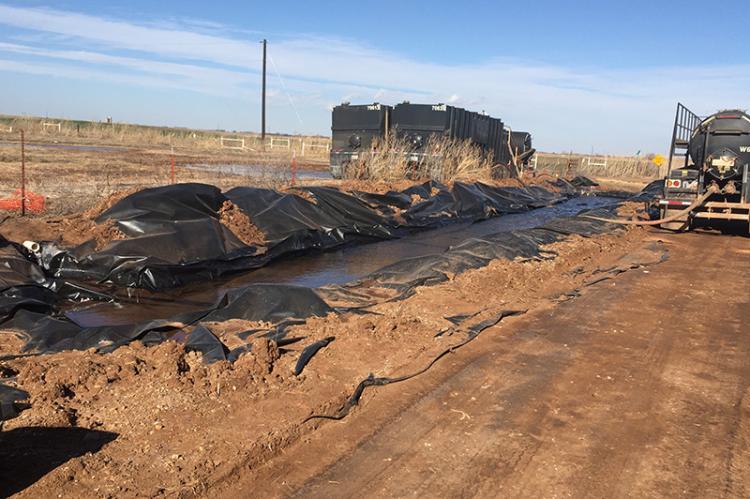
Water flow at an as yet unexplained saltwater purge had dropped off markedly as work continues on a system to contain and remove it from the site southwest of Omega, an Oklahoma Corporation Commission spokesperson said.
From a high of 13 gallons per minute as measured by OCC staff (up to 15 gpm as measured by landowners Donald and Ronald Schweitzer), the flow has slowed to about 6 or 7 gallons per minute, Matt Skinner, OCC public relations manager, said.
The commission’s November order allowed the agency to accept up to $200,000 from the Oklahoma Energy Resources board to install a system of sump pumps and frac tanks to contain the water.
From the tanks, the purge water will be pumped through a new half-mile line to an existing line leading to an existing and more accessible storage site.
“Bison (Oilfi eld Service) will be trucking the water from that site to disposal wells outside the area of concern,” Skinner said.
Hamm and Phillips Service Co. is installing the frac tanks and pump system at the purge site, he said.
To power the pump system, Cimarron Electric Cooperative had to build out about a half mile of new electric line to the site, a project that is expected to be completed Tuesday, Jeff Hyatt, Cimarron’s chief operating offi cer, said.
Skinner said project financing also was still wending its way through the state approval process.
“We expect to get the full green light shortly (possibly today),” Skinner said in an email Friday morning. “The rest of the work should only take a few days.”
In the meantime, the flow continues to be piped into a borrow ditch and then periodically trucked away. Hamm & Phillips Service Co. has taken over water hauling duties from Bison Oilfi eld Services, Ronald Schweitzer said.
While the borrow ditch is lined with a plastic barrier to keep the saltwater from leaching into the soil, nothing prevents it from overfl owing in a heavy rain.
Once installed, the containment system is only intended to mitigate further surface damage while the OCC’s working group, including an engineer, a geophysicist, OCC staffers and oil industry representatives, continues to study the problem.
Landowners fi rst noticed and reported the purge last May when they noticed trees dying and found saltwater bubbling up in the middle of a wheat field just west of the Blaine County line.
Since then, a total of eight disposal wells, seven commercial and one noncommercial, have been shut in indefi nitely by OCC directive.
Injection pressure has been limited on another 12 wells, located primarily in the Watonga area, to no more than 1,000 pounds per square inch.
Because the source of the saltwater hasn’t been identified, it’s not clear whether those actions are responsible for reducing the output.
“It’s about half of what it was, but nobody knows if it’s going to completely quit or keep on running,” Schweitzer said. “It’s all been a slow process. Real slow.”
“Data gathering [and] analysis continues as part of effort to identify a source,” Skinner said.
The Department of Environmental Quality also is working with the OCC to monitor groundwater impact.