
Spring at Last? Maybe
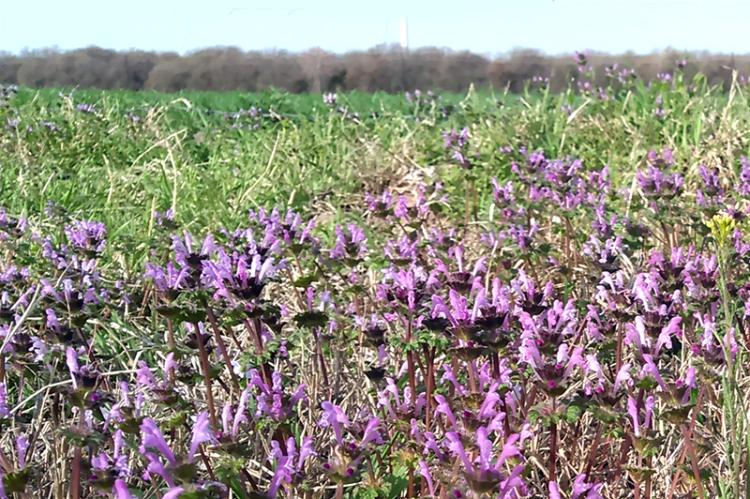
Spring showed its pretty face in Kingfisher County this week after a cold front moved across the area over the weekend.
Waving wheat season has arrived as small grain fields broke winter dormancy and began growing quickly with the onset of longer daylight hours. Early flowers began to bloom and early season grasses and weeds made their appearance.
Cattle have been moved from grain fields targeted for harvest as most fields approached hollow stem stage.
County Agricultural Agent Bryan Kennedy said that any grazing after plants reach the hollow stem stage reduces grain yields.
Henbit and other early weeds also showed their faces on area lawns and fields.
Spring failed to gain a toehold during March, a month that both began and finished with a healthy dose of winter, although spring officially arrived on March 20.
Gary McManus, state climatologist, observed that a cold front plowed through the Southern Plains over the first few days of the month and brought a bit of snow, a bit of ice, and a generous portion of frigid weather. Wind chills fell below zero over much of the state, and as low as minus 12 degrees in the Panhandle. Snow totals were generally light – less than an inch in most areas – although Forgan and Claremore reported 4 and 5 inches, respectively.
Another strong front struck during the last couple of days of March and dropped low temperatures well below freezing across the northwestern half of the state. The Mesonet site at Eva recorded a teeth-chattering 16 degrees on March’s final day. Hail up to the size of baseballs plagued central and eastern Oklahoma associated with a storm system on March 23 and 24.
Perhaps the most damaging March hazard was a windstorm that enveloped the state March 13-14. Winds gusted to more than 70 mph across western Oklahoma, and 50-60 mph to the East.
The Oklahoma Mesonet recorded 303 instances of wind gusts 58 mph or greater on the 13th, the speed required to trigger a severe thunderstorm warning according to National Weather Service criteria.
There were widespread reports of downed power lines and trees, and a fire station in Del City lost part of its roof due to the severe winds.
Several buildings in Kingfisher County sustained wind damage, including the First Nazarene Church building in Kingfisher.
According to preliminary data from the Oklahoma Mesonet, March fell 3.4 degrees below normal with a statewide average of 47 degrees. That ranked the month as the 33rd coolest March since records began in 1895. The chill during that first week was profound.
High temperatures in the Panhandle failed to reach 20 degrees on March 3-4, more than 30 degrees below normal.
Kenton recorded a low of minus 2 degrees on March 5 for the lowest temperature of the month. McAlester broke its record low on March 5, falling to 13 degrees.
The northwest half of the state spent more than 100 hours below freezing during March’s first seven days, with 50-90 of those hours below 24 degrees.
The southeast half spent 50-90 hours below 32 degrees.
There was a bit of spring heat to satisfy warm weather fans, mostly during the latter half of the month. Arnett and Woodward reached 87 degrees on the 28th for the highest mark.
The January-March statewide average of 42 degrees was 1.4 degrees below normal, the 58th coolest first three months of the year on record.
The statewide average precipitation total was 2.58 inches, 0.46 inches below normal and ranked as the 53rd wettest March on record.
There was a wide disparity between rain totals in various regions of the state, however. West central Oklahoma finished with an average of 2.86 inches, 0.57 inches above normal for their 21st wettest March on record.
The Panhandle was close behind at 0.54 inches above normal with an average total of 1.97 inches, their 24th wettest March on record.
Meanwhile, the Southeast was more than an inch below normal at 3.12 inches, the 44th driest March.
While all of the Mesonet’s 120 stations received at least an inch of rain, the majority ended at a deficit for the month.
Boise City recorded the least with 1.16 inches. Cook-son led all stations with 4.66 inches. The first three months of the year saw a deficit of 0.22 inches, the 50th wettest January-March on record.
Kingfisher County ended March with 2.56 inches of rain, under its historic average of 2.99 inches. The March rain brought the year to date total to 4.84 inches – under its average of 5.67 for the first quarter of the year.
Because of heavy late summer and fall rains, moisture conditions remained high across the county.
Following a brief flare up of drought in southwest Oklahoma in late February, enough precipitation fell to reduce that area back to “abnormally dry” conditions on the U.S. Drought Monitor report during March.
According to the April outlooks from the Climate Prediction Center (CPC), chances of that drought returning within the next month are remote.
Those outlooks show increased odds for above normal precipitation across the entire state during April.
Chances are also increased for above normal temperatures over eastern Oklahoma and the western Panhandle.
CPC’s April drought outlook does not indicate any drought intensification within Oklahoma during April.