
A STACK COMEBACK?
O&G pres says renewed oil activity possible, but uncertainties loom large
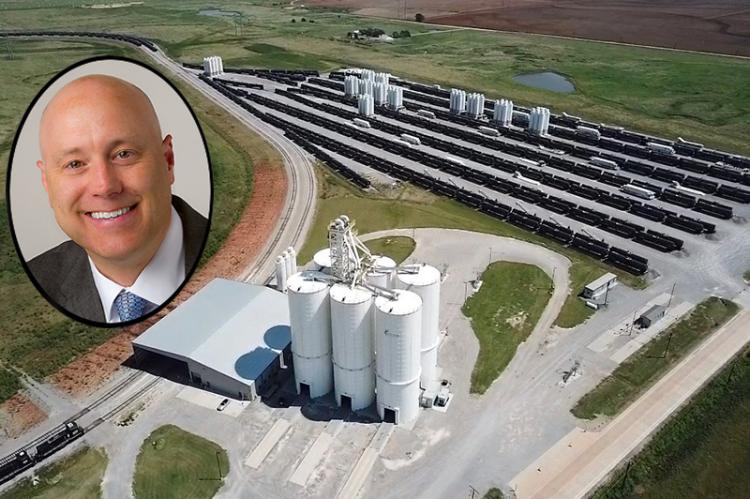
Oil and gas production activity in the once lucrative and robust STACK play in Kingfisher, Canadian and Blaine counties is not gone forever, but exactly when it may come back is difficult to predict.
That’s the message Petroleum Alliance of Oklahoma President Brook Simmons shared on a visit to Kingfisher last Wednesday.
“The STACK is still desirable to producers,” he said. “The question is, at what point does it become economically viable?”
Early Promise
Rewinding nearly seven years to November 2013 when Simmons’ former employer Newfield Exploration first identified and named the oil-rich STACK play in between the Woodford and Meramec shale layers in the Anadarko basin, Kingfisher County’s energy future never looked brighter.
Newfield was an early player in the growing STACK development, investing hundreds of thousands of dollars to secure leases and construct infrastructure over the approximately 165,000 acres encompassed by the play.
Among other things, Newfield constructed a field office near Okarche, a state-of-the-art water recycling facility to reduce its usage of fresh water for fracking operations and a network of underground pipelines.
Other major players soon followed suit, and by 2017 the STACK play and its neighboring SCOOP play to the south combined to make Oklahoma’s Anadarko Basin one of the most productive fields in the country.
At one time, experts were predicting potential total revenues in the area of $40 billion over a boom cycle expected to last 10 years or more.
Lifting All Ships
Increased production activity also brought in oil related service companies with their own multimillion-dollar investments, such as the Solaris rail terminal south of Kingfisher, built to more efficiently receive, store and distribute fracking materials to area wells.
New businesses sprang up further down the food chain, including a new hotel, restaurants and RV parks, and existing businesses and utilities beefed up their products and services to be able to capture more of the new oil money flowing through the local economy.
The boom brought its own growing pains in terms of increased truck traffic and accidents, induced earthquakes, disputes over easements and waterline placements, competition between oil companies and wind farms for use and access to the same land and dozens of lawsuits by local producers over fracking damage to vertical wells.
But the drilling surge also brought increased property and sales tax dollars that financed the construction of schools, roads and other infrastructure and quality of life improvements, as well as corporate donations to build parks and finance classroom enhancement grants for STEM programs.
And individual property owners fortunate enough to own mineral rights also prospered, providing an additional revenue stream that circulated throughout the local economy.
For about 18 months in 2017 and 18, production continued at an impressive pace, with sustained active rig counts in the combined SCOOP and STACK plays hovering around 129 and more than 60 in Kingfisher, Blaine and Canadian counties alone.
Slip Sliding Away
An oil price drop in late 2018 started a slow decline in activity in this area, causing rig counts in the STACK to drop by more than 30%.
Some drilling shifted to Canadian County and farther south to the SCOOP play, but many companies were dialing back their investments throughout the Anadarko Basin or moving capital out altogether.
Even so, some major companies still intended to ramp local production back up once prices stabilized and maintained a foothold in the county, including Newfield’s successor company Encana, which has been rebranded as Ovintiv.
Then along came 2020.
Double Black Swan
In the investment world, an unforeseen, catastrophic event that devastates an economic market is known as a Black Swan.
In the early months of 2020, the oil industry suffered two such events almost simultaneously.
The first was the oil price war between Russia and Saudi Arabia as both countries ratcheted up production and oil prices worldwide went into free fall.
Almost simultaneously, COVID-19 developed into a pandemic and travel, transportation, manufacturing and nearly every other fuel-burning activity worldwide either slowed dramatically or stopped completely.
“Those two double Black Swan events really applied such pressure on the oil industry that it just couldn’t hold up under the circumstances,” Simmons said. “As oil companies saw that price drop combined with near cessation of demand as the economy shut down, the only alternative they had was just stop all activity because they did not have the financial wherewithal to continue.”
Agreed reductions in production in April and June among OPEC countries and another alliance of oil producing companies who are not members of OPEC (known as OPEC+) are making some very slow headway in reducing the massive glut in oil supply.
However, as summer slides into fall with no assurances of whether a second wave of infection will undo the country’s baby steps back to a full economy, it’s impossible to determine when demand for fuel will rebound, Simmons said.
“Right now, we’re still just burning through supply at the pace of ‘weeks to the gallon’ hydrocarbon consumption in the transportation sector,” he said. “We have to work our way through this glut and then achieve a balance between supply and demand for producers to find the way forward.”
Meanwhile, rig counts tumbled to a low of eight or nine in the entire state, small oil companies are failing, larger companies are reorganizing, closing offices and shedding employees through mass layoffs in an effort to cut losses and state government is burning rapidly through its reserves in an effort not to cut services.
“We’ve seen other busts in our lifetimes, but we haven’t seen a bust like this,” Simmons said.
It’s hard to imagine bleaker circumstances under which someone could assume the helm of the state’s largest and oldest oil and gas trade association.
Enter Simmons
But that’s exactly what Simmons did May 1, when he stepped in as PAO president, succeeding Chad Warmington who left at the first of the year to head the State Chamber.
And listening to Simmons talk about the oil industry with a solid understanding of the past, genuine concern for the present and cautious enthusiasm for the future, it’s equally hard to imagine a better person for the job.
He doesn’t relish tough times for the industry, Simmons recognizes the essential truism that adversity breeds both efficiency and innovation.
“We’re going to continue to see consolidations, mergers and acquisitions from this wave of creative destruction and we’ll see new companies, new technologies, new solutions that will drive the next wave of oil and gas development in Oklahoma,” he said.
He noted that the industry appears to have passed through the initial response phases of market shock, followed by defensiveness, where industries are focused primarily on survival and protecting as many jobs as possible and now has moved on to the next phase of “figuring out what the future will look like.
“We’re at a very unique point of this cycle in Oklahoma. We know we’ve passed through the darkest period and we’re starting this slow climb back to normalcy but no one has a clear picture of what that is going to look like.”
Crystal Ball Still Clouded
Muddying the waters are uncertainties, both nationally and within the state, that are beyond the control of the energy industry.
The future course of the pandemic is an obvious one and the Presidential election is another, Simmons said.
“If you have unpacked the 100s of pages of documents Democrats have rolled out over the summer, it’s clear the Biden/Sanders/Ocasia-Cortez plan is not friendly to Oklahoma, not friendly to Kingfisher County and not friendly to the oil and gas sector,” he said.
“What’s our plan going to look like if Biden captures the White House and Democrats capture the Senate?
“Then we have urban, not just left of center, but an extreme socialist mindset controlling the narrative and the agenda in ways that you and I have not seen.
“We got a taste of it under the Obama Administration, when we saw the use of executive orders when even Democrats didn’t want to take up the radical cap and trade plan.
“We’ve moved beyond that into what could potentially look like the Obama Administration on steroids when it comes to anti hydrocarbon agendas.”
Simmons said that oil companies of every size and description need to be more proactive in pushing back against environmental movements that have abandoned concepts of rationality, practicality and reliability when it comes to powering the nation.
“If you take a look at California and the rolling blackouts there, you’re beginning to see the fruits of this extremist environmental overreach and the harm it can present to our day-today lives,” he said.
“We need to be thinking and preparing for that regardless of who is in control of the White House,” he said. “We have to be certain that we are pushing back against the ideas that make no sense for the oil and gas industry or for rural Oklahoma.”
Simmons said uncertainty also exists in Oklahoma based on the unknown ultimate ramifications of the McGirt Supreme Court decision, which held that the original Muscogee Creek Nation boundaries still exist because the reservation was never specifically disestablished by Congress.
[Watch for a more detailed discussion of the decision in a future issue.]
The oil and gas association continues to be a part of the discussion with the Oklahoma Congressional Delegation to determine what federal legislation may be needed to clarify private property rights in the state in the wake of the decision, Simmons said.
The decision presents another factor that investors and developers will take into consideration as they make plans to bring capital back to the state, he said.
“Capital ultimately is a coward,” he said. “When it perceives risks and instability, it’s going to head in another direction.”
Green Shoots Developing
Simmons talks quite a bit about “green shoots” that are already developing from the seeds of his industry’s eventual recovery.
“If you talk to our members, they look at this downturn as not a 2020 story, but a 20-21 story, with perhaps green shoots beginning to appear at the end of this year with some conversations about what does the world look like, where are the opportunities after the bust.
“We’re probably in the very early stages of those conversations.
“The shock has worn off and now people are starting to take stock of what reality looks like.”
Simmons also takes encouragement from the historical resilience of the industry and its ability to find creative solutions in the face of disaster.
“Somewhere out there right now, there’s a young petroleum engineer brimming with new ideas and an old grizzled veteran whose been through these downturns in the past and they’re both thinking about what this industry needs next,” he said.
“Those new solutions born of adversity are going to do wonderful things for our industry, for Kingfisher County and the state of Oklahoma.”