
Standing in the Gap
Local church shares home, others offer resources to offset DHS closure
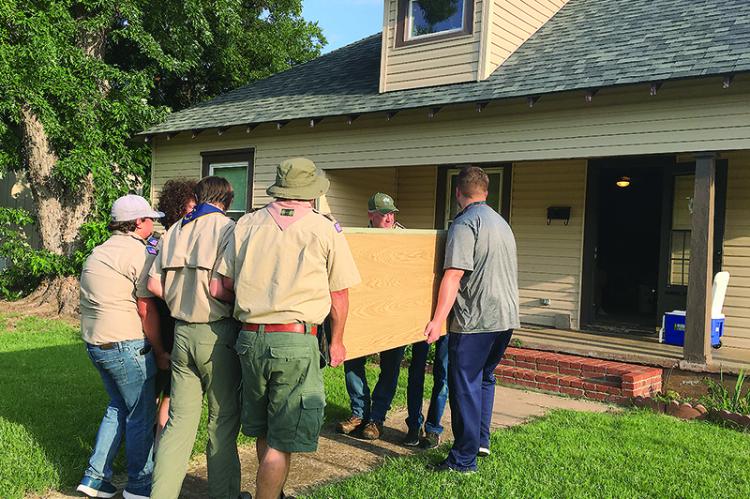
Thanks to one local church offering space and others offering resources, Kingfisher County Department of Human Services will have a home for child welfare services after the local DHS office closes.
But while DHS officials are celebrating the local partnerships they say will provide an even better environment for child abuse and neglect intervention efforts, others continue to have concerns that other social services needs may not be met here and in the 30-some other counties where DHS will no longer have a physical building.
OKDHS announced its plan to close many of its county offices after discovering during the pandemic that employees could operate as efficiently working from their homes.
The closure plan, dubbed “Service First,” contemplates the creation of community partnerships to provide locations for face-to-face services previously conducted at the building located at 102 Coronado on Kingfisher’s south side.
One of the most dire of those needs was a location that could be accessed 24/7 by the child welfare division for not only when at-risk children had to be removed from their homes in emergencies, but also for supervised family visits as parents worked toward permanent reunification with their children.
That raised an interest with Frontline Ministries Pastor Debbie Burpo, a former DHS employee.
“When we were made aware of the DHS need, our wheels began to turn,” Burpo said.
“The house we had hoped to use for our men’s recovery center sits vacant most of the week.
“We felt it would be a perfect place for DHS workers to house children being transitioned into safer environments.”
Tina Frazer, OKDHS child welfare district director, agreed.
“I think it’s not only workable but it’s going to improve and enhance services we can provide to children and families.”
Frazer said the home atmosphere will be a more soothing transition environment for children removed from their own homes in emergencies – sometimes in the middle of the night – who are awaiting placement elsewhere.
“We can bathe kids as needed, get them dressed in appropriate clothing and then have a comfortable place for them to wait while our workers find placements.”
And that same environment can allow for more effective visits between parents and children as families work toward reunification, she said.
“Parents will be able to make meals for their kids during visits, put little ones down for naps and do other things that better demonstrate their parenting skills than just meeting with their kids in an office environment,” Frazer said.
The Frontline partnership also has led to partnerships with other local churches and community entities who are providing furnishings, equipment, toys, meals and other needs for the house, Frazer said.
“The community has been incredibly generous in stepping forward,” she said.
State Sen. Darcy Jech, who has raised concerns about the DHS closure plan, said he was “not at all surprised” that Kingfisher churches and organizations have stepped up.
“That’s the kind of generosity Kingfisher County always exhibits when there are needs to be met,” he said. “Frontline Ministries is always at the leading edge of any kind of service effort, and all our churches and community organizations are quick to step up.”
But Jech said child welfare is only one of the service gaps that will need to be filled when DHS vacates its current location, which has been purchased by the City of Kingfisher to serve as its new police station.
“They also provide other family services and adult assistance programs and I’m not sure those needs can adequately be met without an actual building,” he said.
Jech also noted that not all counties who will lose their DHS buildings have similar resources.
“Kingfisher County is unique in a lot of ways becasue of its strong faith-based community and generous local residents,” he said. “I don’t see that being replicated in counties with higher poverty rates.”
Jech also is concerned about whether DHS has a way to measure the effectiveness of its new plan, or an alternative if the plan doesn’t work.
“I’d like to hear what metrics they’ll use to determine whether needs are being met and whether they have a viable Plan B,” he said.
That’s one of many questions he has for the state OKDHS director as soon as he is able to arrange a meeting. He’s sought input from local professionals and child advocates about their concerns as well.
“It’s been my whole focus since we’ve been out of session,” he said.
Child welfare worker Debbie Osborn, who has been coordinating local partnerships to make sure at-risk families continue to be served, said an open house is planned to allow the community to see the Frontline residence and recognize those who have contributed.
“This community has never failed to step up,” she said.