
State fiscal status good, bad news
Oklahoma’s end-of-year financial report paints a good-news-bad-news fiscal picture for the state.
The bad news is, General Revenue Fund Collections in June came in at $679.4 million, 1.5% below the monthly estimate, total sales tax collections for the year were 1.4% below estimate and the state oil rig count has seen a drastic decline over the last few months.
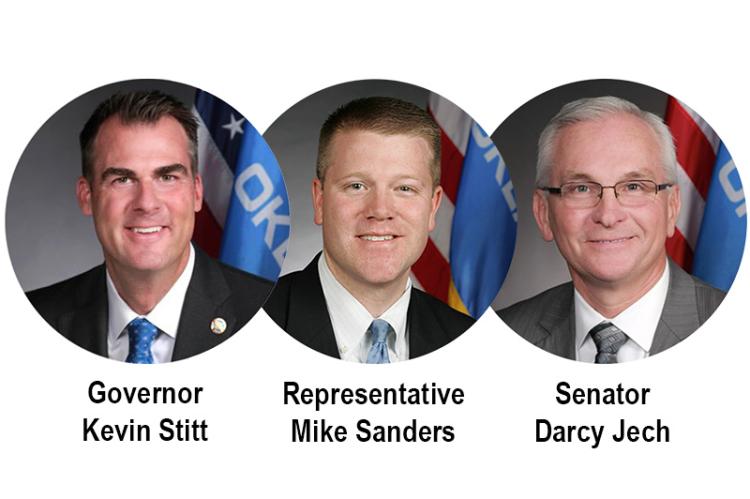
But the good news is, the state is in better shape than ever to weather an economic downturn without massive cuts in services, Gov. Kevin Stitt and local lawmakers say.
“If the June collections are the start of a downward trend, we are better prepared than we’ve been in past downturns,” State Sen. Darcy Jech (R-Kingfisher) said. “The Rainy Day Fund is up to over $800 million and we were able to budget another $200 million in savings.”
“While a significant milestone, we must remember that these [Rainy Day Fund] dollars represent only slightly more than one month’s worth of expenses, which is why I have set a goal of $2 billion in savings to be prepared for the next inevitable economic downtown,” Gov. Stitt said.
“I think we can get to the Governor’s $2 billion goal in addition to other things we need to get done,” State Rep. Mike Sanders (R-Kingfisher) said. “We have a history of spending all the money like drunken sailors in good years and then there’s nothing to backfill when there’s a downturn.
Despite the June downturn, total General Revenue Fund collections for FY 2019 came in at nearly $6.9 billion, more than a billion dollars over 2018 collections and the largest deposit the state has ever made, according to the final report from the Office of Management and Enterprise Services.
Additionally, while total sales tax failed fell below expectations, all other major tax categories exceeded the estimate for the fiscal year:
•Total income tax collections of $2.6 billion were $197.0 million (8.2%) above the estimate and $240.7 million (10.2%) above 2018.
•Individual income tax collections of $2.3 billion were $91.8 million (4.1%) above the estimate and $191.6 million (8.9%) above 2018.
•Corporate income tax collections of $241.9 million were $105.2 million (76.9%) above the estimate and $49.1 million (25.4%) above 2018.
•Gross production tax collections of $725.9 million were $171.2 million (30.9%) above the estimate and $372.5 million (105.4%) above 2018.
•Natural gas collections of $369.2 million were $35.7 million (10.7%) above the estimate and $125.3 million
(51.4%) above 2018.
•Oil collections of $356.7 million were $135.5 million
(61.2%) above the estimate and $247.2 million ( 225.7%) above 2018.
•Motor vehicle tax collections of $223.8 million were $2.9 million (1.3%) above the estimate and $8.3 million
(3.8%) above 2018.
•Other revenue collections of $1.2 billion were $14.3 million (1.2%) above the estimate and $383.6 million (48%) above 2018.
“Oklahoma’s economy continues to grow at a moderate pace and our Commerce Department is hitting significant milestones in job recruitment,” Stitt said. “We are also actively monitoring the effects of a drastic decline in rig count and other economic factors that give risk to a slowdown.”
“If we continue to not hit the mark in terms of other revenue collections, sure we are concerned about that, but right now unemployment numbers are still low and sales tax is still strong as compared to previous years,” Sanders said. “We’ve met a lot of needs in the last couple of years and I still believe in our economy.”
Jech noted the Legislature “made some tough choices a few years ago that have helped the state be in a better financial position now,” as well as implementing changes that create more fiscal accountability.
“Senate Bill 1, the bipartisan bill that created LOFT (Legislative Office of Fiscal Transparency) will give future legislatures more effective oversight over agencies missions and spending,” he said.
While not adopted as a revenue saving measure, recent criminal justice reforms should also have a cost-saving benefit, Jech added.