
Stricker gets life sentence
County jury convicts him in girlfriend’s 2019 murder
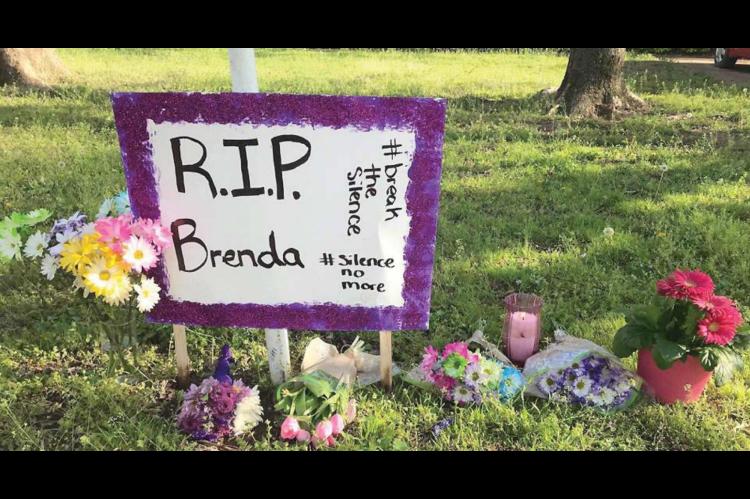
District Judge Paul Woodward sentenced Steven Stricker, 64, to life in prison Thursday afternoon after an eight-man, four-woman Kingfisher County jury convicted him of second-degree murder in the 2019 death of his girlfriend Brenda Baber.
Stricker was sentenced to an additional eight years for desecration of a corpse, to which he had pled guilty moments before opening statements began Tuesday morning.
The sentences will run consecutively and Stricker will be given credit for the nearly two years he’s already served awaiting trial in the Kingfisher County Jail.
Although the state was seeking a first-degree murder conviction and a sentence of life without the possibility of parole, Assistant District Attorney John Salmon told the Times & Free Press Friday that Stricker’s actions to dismember Baber’s body with a kitchen knife, burn her remains in an indoor fireplace and outdoor fire pit and then pulverize the bones made it a difficult case for the jury.
“This was a very difficult case from an evidence standpoint based upon the concealment efforts taken by the defendant,” he said.
“Thankfully the jury’s verdict provides justice and some closure to Brenda Baber’s family.”
Salmon, who prosecuted the case along with Assistant District Attorney Eric Epplin, added:
“We are very lucky to have had a great investigation by the Oklahoma State Bureau of Investigation, the Kingfisher Police Department, and the state medical examiner’s office.
“Without their hard work, this case would’ve been impossible to prove.”
The jury deliberated for about four hours before rendering their verdict, at the conclusion of three days of frequently grizzly testimony.
In the course of a lengthy videotaped interview played for the jury, Stricker eventually admitted to two Oklahoma State Bureau of Investigation agents, that he dismembered and cut up Baber’s body in the bathtub of their residence, beginning in the early morning hours of April 2, 2019.
He said he burned the remains over a 12-hour period in his living room fireplace and then used a framing hammer to pulverize the charred bones.
Stricker was interviewed April 5 at the Kingfisher Police Department, following his arrest by OSBI agents at Boom-A-Rang restaurant in Kingfisher, where he was employed as a cook.
While Stricker was being interviewed, other OSBI agents, Kingfisher police officers and a forensic anthropologist with the state medical examiner’s office were serving a search warrant at the home rented by the couple at 421 W. Sheridan Ave.
Ultimately, pieces of human bone and charred flesh were found in the fireplace, in an outdoor fire pit and strewn about the backyard and a raised garden, according to testimony.
A trail of bone fragments also was found in and beside an alleyway leading to the polycart where Stricker said he disposed of several grocery bags of remains that were later picked up by the city’s sanitation contractors.
Police Capt. Travis Gray described how he and an OSBI agent visited the landfill near Union City two days later looking for the grocery bags Stricker described, but were unable to locate them in the tons of trash that were dumped there since the Kingfisher garbage pickup.
Gray also testified to another grisly find by Kingfisher Water Department Superintendent Jeremiah Homier, who reported that material resembling human remains were found in the city’s solid waste trap at a sewer lift station weeks after Stricker’s arrest.
On two occasions, Gray and OSBI agents visited the lift station and the wastewater treatment plant to collect what appeared to be human bones and flesh, according to testimony.
The knife Stricker said he used was recovered in a kitchen knife block and the framing hammer in the garage after Stricker described them and their location during his interview.
Both the knife, which later tested positive for Baber’s blood, and the hammer were shown to the jury during the trial.
A number of blood stains also were identified in the bathroom and other areas of the house that later were identified through DNA as likely belonging to Baber.
Despite his eventual admission as to his actions after Baber’s death, Stricker insisted during his interview that her death was an accident.
He told law enforcement that he and Baber got into an argument in the bathroom in the middle of the night while she was seated on the toilet, that at some point she got up and was “nose to nose” with him where he stood in the doorway and then tried to step around him and “ended up in the bathtub” where she apparently hit her head and died.
Police began investigating Stricker on April 4, when Baber’s sister called to report her missing after the sister and other relatives arrived in town at Baber’s request with a rented U-Haul truck to move Baber and her possessions to Cushing at Baber’s request.
While police were at the house conducting a welfare check, a backyard neighbor told them he’d seen Stricker “messing around in the garden” and using his patio burn pit in the days prior.
The neighbor testified at the trial that the actions caught his attention because the couple’s home had been sold by their landlord in the city’s FEMA buyback program and was slated for demolition.
The neighbor also described seeing Stricker sitting on the back patio drinking a beer while burning something in his fire pit.
Evidence, including security video, bank records and store receipts also was presented that after Baber’s death and the time period when Stricker said he disposed of her body, he used her debit card to purchase two cases of beer and a carton of cigarettes at Brick’s Corner Store.
Police also testified that Stricker had two previous convictions for domestic abuse against Baber in 2011.
Stricker did not testify on his behalf and the defense put on no witnesses, but his attorney Jarrod Stevenson of Oklahoma City told the jury in his closing statement that the fact that Stricker was willing to admit to the mutilation and disposal made his claim that he didn’t kill her more credible.
“What he did to her after her death is almost worse than killing her,” he said. “Does it make sense that he’d be willing to admit to that and he’s not willing to admit to killing her?”
However, Epplin argued that Stricker only made admissions when he was “backed into a corner” by the discovery of evidence, that his story of how Baber fell into the tub without any contact from him “is pure lunacy” that defies the laws of physics and reason and that it was impossible to know exactly how Baber died “because he did not want us to know and his actions made sure we didn’t.”
He asked jurors to consider the total picture painted by witnesses as to Stricker’s comments before the crime to an internet girlfriend and after the fact to his sister and mother that suggested he intentionally killed Baber to prevent her from leaving him, as well as the extent to which he attempted to hide the death.
“The effort you go to in order to cover up your crime is clearly relevant as to the homicidal nature of the crime itself,” he said.