
Tale of Two Nellies
Nellie Sanders shares great-grandma’s story
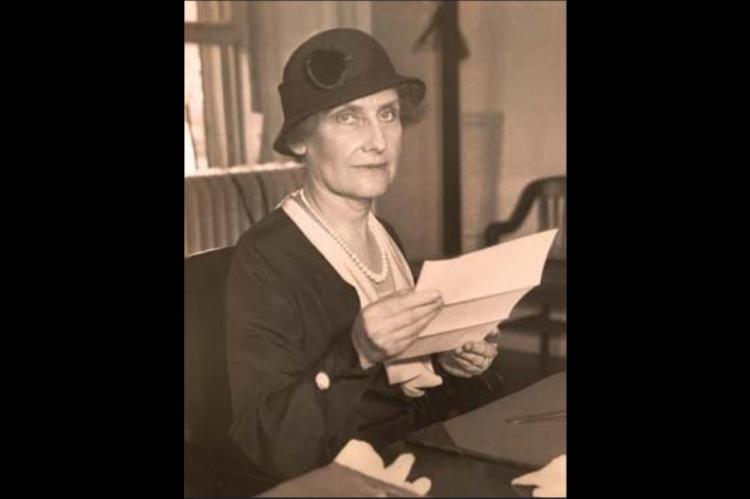
[Ed. Note: Nellie Sanders presented a program at Wednesday’s Kingfisher County Republican Women meeting on the life of her great-grandmother Nellie Tayloe Ross, first female governor of Wyoming and first female director of the U.S. Mint. The following is a transcript of Sanders’ speech.]
On Jan. 5, 1925, a recently widowed wife and mother was inaugurated as governor of Wyoming. Nellie Tayloe Ross was the first woman governor in the U.S. and the only female governor of Wyoming, to date.
It’s hard for me to give a speech about Nellie and not include my father. My dad, who passed away two years ago, was named William Bradford Ross III, and he was our family torch carrier for all things “Nellie” and her beloved grandson.
I am proud to now carry that honor forward for my family.
When I think about my dad and Nellie I’ll never forget my dad saying “that this incredible lady just picked up and kept going – and just kept going – and just kept going, and it lasted over 100 years, that life, and it was an incredible life,” when describing the courage it took to step into the role of governor after the sudden death of her husband, then Gov. William Bradford Ross.
After Wyoming lost its 12 th governor, my great-grandfather William Bradford Ross who died in 1924 of complications from appendicitis, his widow was thrust into a position of sustaining a state, while she had little time to mourn and no time to contemplate her options.
She stepped into her husband’s role and carried on with his responsibilities, while she continued to raise her 12-year-old son, William Bradford Ross II, who was my grandfather.
An interim governor was named to complete her husband’s term and then Nellie was asked to run for the seat, easily winning election to a two-year term from 1925-27. In her term, the country saw Yellowstone named the first national park, which was officially opened in 1925. She was an advocate for fairness, rights for women and children and stood firmly for strong prohibition laws.
She ran for reelection a second time, but with her firm stance for prohibition, hers was not the popular platform and she lost.
The Republicans took all five of the top elected state offices. Nellie’s race was by far the closest of these. She lost by only 1,365 out of about 70,000 votes cast.
Even so, this was just the start of Nellie Tayloe Ross’ long career in politics.
The following year, she traveled the nation giving speeches on the Chatauqua Circuit and got to touch rural communities like Kingfisher throughout the West and Midwest.
(Kingfisher was part of the Chatauqua Circuit, but Sanders has no information as to whether her namesake ever spoke here.)
In 1928, New York Gov. Al Smith won the Democratic nomination for president. Nellie, now one of the most famous Democrats and one of the most famous women in the nation, campaigned extensively for him although she disagreed with him on prohibition.
At the 1928 Democratic National Convention, she received 31 votes from ten states for vice president on the first ballot. She also gave a speech seconding Smith’s nomination.
When Smith lost to Herbert Hoover, Nellie was offered the salaried job of director of the Women’s Division of the National Democratic Committee. She moved to Washington D.C., leaving Wyoming more or less for good. In her new position, she directed the campaign for the women’s vote for Franklin D. Roosevelt.
This begins Nellie’s extraordinary journey into politics. She had more challenges and barriers for a woman with no real job experience except two years of kindergarten training, no higher education or training but she rose to the occasion and became known as a confident and effective public administrator praised for her leadership skills by all who worked for her.
Don’t be mistaken; it wasn’t easy and Nellie faced an unreal amount of discrimination and resentment from some of her male associates, and she also aroused the enmity of Eleanor Roosevelt, whom she displaced at the Democratic National Committee.
Despite all of this, nothing would stop her from being a staunch supporter and close ally of Franklin D. Roosevelt and his “New Deal Politics.”
She campaigned for him and was appointed director of the U.S. Mint, another first for women in history.
She spent 20 years in this position and was the first woman to have her likeness on a mint medal and a build ing cornerstone.
During her 20-year term the mint introduced the Roosevelt dime, the Jefferson nickel, and the steel penny, the latter an emergency measure during World War II.
She was known as an eloquent speaker and toured the country, advocating reform and human rights.
Few people knew she had an all-consuming fear of mice. Once during a speech, a mouse ran across the stage and Nellie screamed and jumped up on the podium until it was gone – and then got back down and continued to speak as if nothing had ever happened.
Born Nov. 29, 1876, Nellie Tayloe Ross was educated in Missouri and Kansas, graduating from teacher’s training school. While teaching kindergarten, she met her future husband, whom she married in 1902.
The couple had four sons, the eldest being twins, George Tayloe and James Ambrose born in 1903. Alfred Duff was born in 1905 and later died at the age of 10 months. William Bradford, the youngest son and my grandfather, was born in 1912. He was 12 years old when his father died and carried on the name for many more generations.
Nellie was an advocate of the 1920’s Democratic Party. She lived out the remainder of her life in Washington, D.C., working in the U.S. Mint, actively involved in politics and setting the precedence for her children.
She died at the age of 101, survived by two of her sons, four grandchildren and six great-grandchildren.
My father proudly used to share the important path his grandmother paved for women, not only in Wyoming, but in America.
He used to say so many women have mirrored her in their lives. He would say that young people should learn about her, they should know there was a woman who was governor, a director of the U.S. Mint, who had been there – and done it all.
I can’t begin to express how protective of Nellie’s legacy I am. I want people to know that she was not a feminist (as many women in leadership roles were at that time) and she believed in family being number one.
She faced a terrible situation in the sudden loss of her husband and had to do what she could to make ends meet for her family.
It so happened that Nellie was her husband William’s closest adviser and that she too shared a passion for politics. It was this passion that made her so successful as the first woman governor and first woman director of the U.S. Mint, which is what brought the Ross family to Washington, D.C. where I was born and raised.
In many ways, I feel it’s my responsibility to be sure that when Wyoming has visitors like Hilary Clinton, who happen to be running for president and use my great-grandmother’s good name for political gain, I want to be sure the message is clear about what Nellie represented.
It was never about being the nation’s first female governor or using her husband as a stepping-stone in her political direction of choice. Nellie couldn’t even begin to relate to someone like that but as we know people are working hard to erase history. As we celebrate 100 years
As we celebrate 100 years since women got the right to vote and Nellie has been placed back in the headlines for having her picture among 14 other historic women on Mt. Rushmore for two weeks in August to honor those who made the biggest impact for Women’s Suffrage, I feel it’s my responsibility to be sure history is written correctly when it comes to her drive to be the first of her kind in America.
As a tiny young girl, I remember my father telling me that I was named after the first woman governor in the U.S. and that she was my great-grandmother – that she and my great-grandfather were the first husband and wife to be independently elected governors.
In our family Nellie’s called “Gah,” a name my dad gave her when he was a baby. My dream is for my own great-grandchildren to learn about their Gah and know they can look her up and trust what they read about her is correct.
I’m so proud to be her namesake. My dad loved her very much and used to tell me how much I reminded him of her. She lived to be 101 years old, so she and my father had a lot of time to enjoy one another.
They traveled the world together. In many ways, my father was her closest companion. I still can’t figure out how I came out looking the most like her of everyone in my family. My cousins even tease me about it when we’re together for the holidays. When you see her picture on Mt. Rushmore in a few weeks and think it’s me just know that the genes are strong between us! Ironically, I feel that I’m following in Nellie’s footsteps in many aspects of my own life.
When Michael was first elected to his current position in the legislature I found myself searching for articles and speeches she had done just to get advice from her in balancing it all…a new state... newborn babies…political life….and being a wife.
I really held on to the fact that she put her family first and led based on her passion for serving others. I can’t begin to tell you how much that helped me in navigating the new waters of our political lives. Both William and Nellie truly worked hard to make Wyoming the best possible place it could be, and I feel so much pride in knowing that both Michael and I work hard to do the same for Oklahoma.
So, to set history straight woman’s suffrage was not Nellie’s main concern. She cared about her family, but she also cared deeply about getting things done in the public sphere – that is, about politics.
She was born during the presidency of Ulysses S. Grant and died in 1977, at the age of 101, during the presidency of Jimmy Carter.
Born exactly 100 years after the signing of the Declaration of Independence, Nellie lived to celebrate the nation’s bicentennial, so her long and remarkable life precisely spanned the second U.S. century.
She was reared in the Victorian era, when upper-and middle-class women were expected to be domestic, decorative and submissive, but she died as the women’s movement was creating a multitude of opportunities for young women of the 1970s.
She followed her ambition, saw her opportunities, took up the power available to her, and used it for good.