
From TBI to PhD
In years following massive head injury, Okarche woman earns 4 degrees
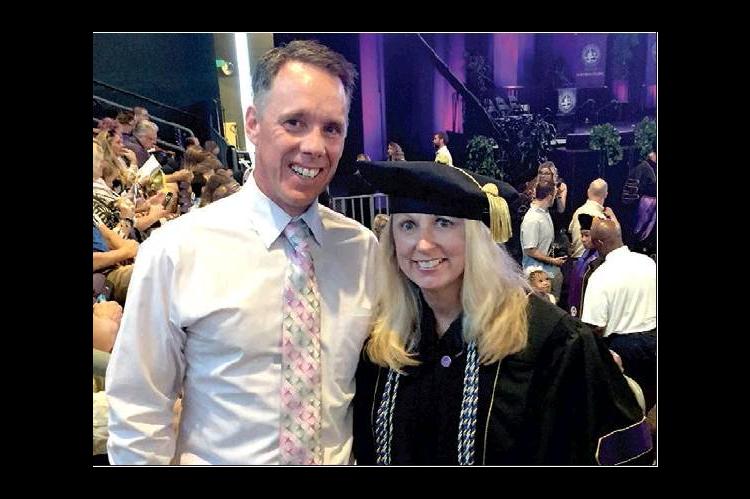
Shari Beecher’s first coherent thought 23 days after the car she was riding in was T-boned by a drunk driver on Lake Hefner Parkway in Oklahoma City:
“Why am I in a cage?”
Shari found herself in a room at Jim Thorpe Rehabilitation Center, her bed zipped inside a mesh cube that kept her from wandering out of it, her shattered jaw wired shut.
She and her husband Kurt remember none of the Nov. 7, 2000, Oklahoma City accident or the month or so following it and only fragments of their lengthy rehabilitations.
What they do remember from that time period is mostly what they’ve pieced together from other people’s recollections – the Deer Creek EMT who was the first on the scene, the astonished doctors who’ve become close friends, their family members who helped with their care – and the horrific photos of what’s left of their car and of the two of them in their separate hospital rooms.
Now, sitting in the living room of the rural Okarche home they built after the accident, Kurt has one overriding thought:
“It’s a miracle we’re even alive.”
Actually, survival turned out to be the first of many miracles over the last 19 years.
The latest one happened this spring, when Shari graduated with honors from Grand Canyon University in Arizona with a doctorate in industrial and organizational psychology.
In fact, after waking up from a brain injury that required her to relearn not only walking and talking but also the most rudimentary fundamentals of self care, this former average student has earned four post-secondary degrees with a near perfect GPA.
Surviving ‘A Double-Fatality’
The series of miracles started with Shari being brought back to life on the side of the road when her heart stopped more than once, then surprising everyone when she completely recovered from her post traumatic amnesia after 23 long days, when anything longer than seven days heralds a grim prognosis for future brain function.
(She was awake and attempting to communicate through her wired jaw during those 23 days, but retained none of those conversations, often asking the same questions over and over.)
Because of her brain injury, she also was paralyzed from the waist down and couldn’t use her left hand.
Meanwhile, Kurt took the brunt of the impact as the other car slammed into the driver’s side in the middle of a full spin.
His legs were trapped under the dash while his torso was thrown into the passenger seat. His pelvis was crushed and separated from his spine on the right side, his leg was fractured in several places, his tailbone was broken and the gearshift punched through his diaphragm, forcing all his organs up into his chest and deflating both lungs.
In fact, the accident was so horrific, it was initially called in as a double fatality, because neither of the Beechers was thought to survive.
(With seven DUI convictions on his record yet still behind the wheel, the driver of the other vehicle suffered only minor injuries, the Beechers said.)
While Shari was being resuscitated and stabilized before being sent to OU Medical Center in an ambulance, other rescue workers were using the jaws of life to free Kurt from the car and send him to OU in a second ambulance.
Kurt underwent several surgeries over the next few weeks, with OU’s best-of-the-best, the head of the medical school’s orthopedics department, holding the scalpel.
Two surgeries were needed just to repair his diaphragm and relocate his organs back into his abdominal cavity.
After so many surgeries mending his pelvis and broken leg, the separation between Kurt’s pelvis and spine was left to heal on its own, which doctors warned could leave him with one leg significantly shorter than the other.
The bones mended with only two millimeters difference between the length of his legs and no noticeable limp, something his surgeon said he’d never seen happen.
The Hard Work Begins
While surgeons spent weeks painstakingly piecing Kurt back together, Shari had been transferred to Jim Thorpe Rehabilitation Center to begin intensive therapy.
“Each day, I had six hours of rehab – two hours of occupational therapy, two speech and two physical,” she said. “When one therapist would bring me back to my room, I would collapse on the bed and be instantly asleep and the next thing I knew, another therapist would be waking me up to do some more.”
Everything Shari could do previously without thought or effort required conscious thought and the utmost concentration.
“I had to literally tell my leg to lift and move forward, because it wasn’t an automatic process anymore,” she said. “I had to get those neuro connections working again and it was exhausting.”
Part of her speech therapy involved teaching her how to swallow again, so she wouldn’t choke on her food.
Activities that required a combination of mental thought and physical activity were particularly challenging.
“It was so hard to learn to write,” she said. “When I first got out of Jim Thorpe, it took me 15 minutes to write one check.”
While the work was grueling and the steps toward recovery seemed infinitesimally small, Shari was doing some surprising healing of her own.
Her shattered jaw mended without losing a single tooth and a retainer she wore before the accident still fits.
Her eyes no longer tracked together due to the head injury, leaving her with double vision, but she found herself in the care of a neuro ophthalmologist whose medical practice was guided by faith.
“He said we would give it time to see how much my eyes would start moving back towards tracking together on their own and then he would do surgery to finish the correction,” she said. “He actually prayed over me at every office visit.”
Millimeter by millimeter, her eyes began to improve.
“A year and a half later, the doctor said I wouldn’t even need surgery,” she said. “God had healed me.”
When Kurt was finally released from the hospital, he was transferred to Jim Thorpe to start his own therapy, and the couple lived together in the same apartment to learn how to care for each other as well as themselves.
“I was sitting in my wheelchair looking at her struggling with her brain injury and thinking, ‘man, I’m glad that’s not me,’” Kurt said. “It wasn’t until much later that I learned she was looking at me in my wheelchair at the very same time and having the very same thought.”
The Road Home
The couple was released from Jim Thorpe shortly after Christmas. Still struggling with double vision, Shari had to take a driving test through Jim Thorpe to get a provisional license.
“Basically, I had to just drive with one eye closed so that I wasn’t seeing two of everything,” she said.
The Beechers remember the first days and weeks when they would both stagger from their car seats – Kurt hopping on one leg and Shari leaning on the car to maintain her fragile balance – and meeting at the trunk to lift out his wheelchair together.
Shari’s jaw remained wired shut until February when she discovered that new freedom brought new challenges.
“The first place I wanted to go was Hideaway Pizza, but I couldn’t chew anything because my jaw was so weak,” she said. “And my brain injury had my tastebuds all messed up, so tomato sauce tasted like frosting.”
In fact, mint and chocolate were the only two flavors that still tasted right to her, “so I had mint chocolate ice cream a lot.”
Blazing a New Trail
Several months later, Kurt was finally out of his wheelchair and gradually able to return to his job at AT&T.
But progress was slower for Shari and often more difficult to measure or even recognize.
Her treacherous balance would (and occasionally still does) cause her to fall without warning.
Days of mental clarity would be followed by days of exhaustion and brain fog when even the simplest of tasks seemed beyond her.
Even four years later, Shari still struggled with her longterm, often frustrating and always exhausting recovery process.
Which is why she resisted an unexpected and inexplicable urge to go to college.
“I fought with God for three more years because he was telling me to go back to school I said I didn’t think I could do it,” she said. “How am I going to remember this stuff and take tests?”
She finally gave in and enrolled at Redlands Community College in 2007 and finished two semesters before she told anyone besides Kurt that she was even a student.
“I didn’t want anyone feeling sorry for me if I didn’t make it,” she said.
But she did make it, not only completing an associate’s degree in psychology in two years, but earning all A’s and qualifying for Phi Theta Kappa honor society.
She followed that two years later with a bachelor’s degree in psychology from the University of Science and Arts in Chickasha and then two years after that she completed a master’s degree in experimental psychology from the University of Central Oklahoma, earning all A’s through both programs and graduating with honors and as a member of Golden Key at UCO.
She developed a love of research as an undergraduate at USAO, which led to her choice of experimental psychology as her area of emphasis for her master’s degree.
“There’s a lot of math involved and I loved that,” she said. “Come to find out that ‘s the toughest program to be in.”
With an adviser who wasn’t particularly helpful, Shari had to learn much of the research process on her own – how to design an experiment, how to collect and analyze data, how to explain and defend her conclusions.
“I was lost and frustrated. I would ask questions and get no feedback,” she said. “I didn’t want them to do it for me, but I still had questions on the process. That was the hardest thing.”
This spring, she completed an online doctorate program at Grand Canyon University in Phoenix, Ariz., in industrial-organizational psychology.
In doctoral classes where an A required a final score of 97 or better, Shari received her very first and only B as a college student – with a score of 92.
Out of 30 students in her class who started the arduous dissertation-writing process, Shari was one of only three who finished – and she did it in 18 months.
Kurt said he wasn’t at all surprised at his wife’s academic success, which he said was nothing more than the product of years of extremely hard work.
“What I would see her do was studying eight hours for what a normal student might spend 20 minutes on. It wasn’t because it came easy for her or because anyone was making it easy,” he said.
“I had no doubt she could do it, but it was still painful to watch, especially in the master’s program.
“It emotionally drained her to point she would come home crying.”
But for Shari, hours spent in front of a computer focusing on some particularly thorny academic question is actually easier on her brain than a simpler task that involves more social interaction.
“What I’ve noticed over the years is that I would be more exhausted being social and talking,” she said, slipping easily into a psych class explanation.
“Every second, we are bombarded with 5,000 pieces of sensory information, but our brains can only process 3,000,” she said. “I’ve come to realize it’s even more taxing on me and my brain works harder trying to understand its environment.
“I can sit in front of the computer and stare at it all day because it’s only one thing to focus on, but going to Walmart exhausts me.”
On to Helping Others
Combining her love of data and research with her desire to help others choose the right career fit, Beecher is working towards applying her degree to the field of aptitude testing for high school students.
Currently, Dallas is the closest location parents can obtain extensive testing to help their students make informed decisions about higher education and ultimate careers.
“As the family farm is starting to decline, there’s going to be a need to get these kids more of an understanding of what else may be out there and what they’d be good at.
“I’m passionate about helping people be successful.”
Holding It Together
Still friends with many of their doctors, the Beechers say the professionals continue to be amazed – not only by the progress both of them have made but by the fact that they remained a couple.
Statistically, up to 78 percent of marriages end in divorce after one spouse suffers a traumatic brain injury. When both spouses are critically injured, they face even greater relationship challenges.
But if you’re looking for the Beechers’ secret, they both say they have none.
“I have no other answer than to say that every aspect has been a miracle that is totally out of my hands,” Kurt said.
“Keeping our marriage together wasn’t even on my mind, and honestly, with my brain injury, not much was on my mind,” Shari said. “I seriously couldn’t imagine why people would get divorced during a time when you so desperately need each other.”