
They really do like to move it, move it
Lomega FFA’er says raising boisterous lemurs is a blast
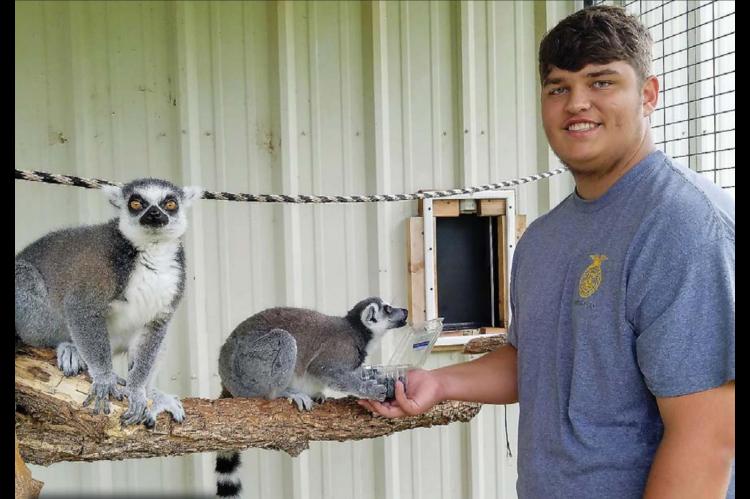
Ring-tailed lemurs.
No stranger to successfully raising show pigs, goats, chickens and rabbits, Isaac Kerr has recently branched out to a new breed.
Ring-tailed lemurs. Although he won’t be showing his lemurs in traditional stock shows, Kerr will be raising awareness for the endangered species through his supervised agricultural experience (SAE) project with Lomega FFA.
Students can choose an individual project while in FFA, which provides an opportunity to have a work-based learning experience in their area of interest.
The goal of SAE projects, Lomega agriculture education instructor Laramie Lopp said, is for students to learn responsibility, record-keeping and valuable skills, under supervision of an FFA instructor.
Raising lemurs is a bit unusual, but Kerr said he came up with the idea from a friend who had raised them.
About one and a half years ago, he contacted his friend and was able to purchase two ring-tailed lemurs – a 2-year-old male, King Julian, and a 3-year-old female, Queenie.
In preparation for the lemurs’ arrival, Kerr and his dad built a large outdoor enclosure behind the shop at their residence east of Kingfisher. They added branches and ropes for swinging and other toys to keep the lemurs entertained.
“They are very intelligent and went through every nook and cranny when we introduced them to their pen,” Kerr commented.
Unique to Madagascar, an island off the southeast coast of Africa, ring-tailed lemurs are currently on the endangered species list due to loss of their natural habitat and other factors.
Agile jumpers and climbers, ringtailed lemurs are social animals and typically live in groups of about 20 in their natural habitat, Kerr said.
They generally have happy and energetic personalities, but can be aggressive, he said, and added that King Julian and Queenie weren’t overly friendly when he brought them home.
“I have spent hundreds of hours sitting with them to tame them to the point they are now,” Kerr said.
All that time and effort has paid off. Julian and Queenie are literally eating out of Kerr’s hand and leisurely sitting on his shoulder.
Ring-tailed lemurs typically have more personality than other types of lemurs, Kerr said.
An unusual trait for primates, the female is the dominant figure over the male. Queenie exhibits that behavior and is very protective of King Julian, Kerr said, but also is generally happy and super energetic. King Julian’s personality is more laid-back and tame, he said.
Primarily herbivores, their diet consist of blueberries, craisins and bananas, as well as a commercial primate food in the form of large pellets or nuggets. They go through a 20-pound bag of the primate food about every month, Kerr commented.
“They also love mangoes,” he said, “but only get those on special occasions.”
As for the climate, they are very adaptable and are doing well in the Oklahoma heat, he commented.
One of the initial challenges Kerr experienced was a rush to add an indoor enclosure to the existing one in anticipation of a snowstorm, but with the help of his father they completed it quickly as snow began to fall on the lemurs. They added heated mats to the flooring and heated water bowls to make the lemurs comfortable.
“The lemurs are very healthy and have never been sick,” Kerr said.
For vaccinations, he takes the lemurs to the Oklahoma City Zoo because most rural veterinarians are not licensed to treat primates.
When questions or concerns arise with the lemurs, Kerr said he also reaches out to a primate sanctuary in Newcastle for answers.
Because primates are closely related to humans, they can share some diseases and coronavirus is one of them, he said, so he has to take extra precautions during the pandemic.
Kerr has prepared an informational slide show to educate people about ring-tailed lemurs and the endangerment of the species. Several schools have contacted him regarding a presentation and he hopes to be able to do that when the pandemic is over, he said.
As a freshman, Lopp said, Kerr held two offices in the local FFA chapter, sentinel and parliamentarian, and added that he is a hard worker.
“Having lemurs as a SAE is definitely a unique project,” Lopp said.
Kerr moved to the Kingfisher area over two years ago with his parents, Richard and Angela, who are very supportive of his FFA project.
Angela is a teacher at Lomega schools and Richard is employed in the oil and gas industry. He also has an older sister, Claire, who is a student at Arkansas Tech University.
Other activities Kerr is involved in are basketball and academic team as well as taking concurrent college courses at Redlands Community College.
He is glad he chose the lemurs for his project, Kerr said, and is hopeful Queenie will have a new addition for the family in the spring.
When Kerr was asked if he has any advice for future FFA students who want to tackle a project that is a little different than the norm, he said, “Do it! It’s a blast.”
“You are only in FFA once, make the time useful.”