
Tiny town morphs into popular central OK suburb
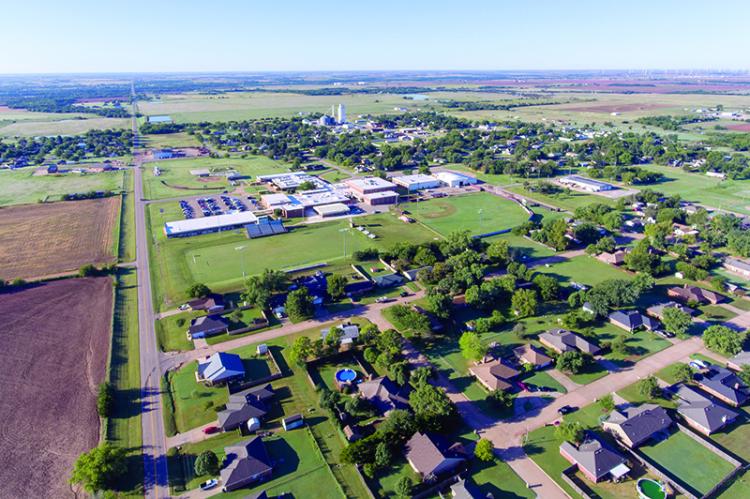
Cashion goes BOOM
Cashion is a town on the move, thanks at least in part to the Kingfisher County oil boom in the STACK.
Anita Robinson, owner of Gateway Realty at Cashion, says at this point there are more inquiries from people wanting to move into Cashion than there are homes available to buy.
That situation has resulted in the proposed development of Cashion Estates, an 88-lot addition one mile north of Cashion on the west side of S.H. 74F. The developers bought a 109-acre tract so there is room for additional growth as needed.
Cimarron Electric Cooperative will provide electricity to the addition and the town of Cashion will provide trash pickup.
Verde Ridge, also north of Cashion, is another addition that is quickly filling up.
Robinson said an earlier housing addition, Pioneer Ridge, has already filled up and the developers are considering a second phase.
She said Cashion’s close proximity to Oklahoma City, its outstanding, though still small, school and small town flavor all combine to make it a target for families wanting to leave large city congestion.
She said while the Cashion school enrollment has grown some 100 students in the last two years, it is still small enough for all students to find a place where they can participate.
Several retail store chains have indicated interest in opening in Cashion in recent months but nothing definite has occurred yet.
Deer Creek Medical Clinic has opened a location in Cash-ion and a second medical clinic is in the process of opening there.
Cashion Grain and Feed, a long-time fixture at Cashion, dominates the landscape with its large grain elevators in the downtown area.
One setback has been the closing of the popular downtown Cashion cafe.
Robinson says the upside is that the location is for sale and fully equipped to go back into operation immediately.
Two gas plants operate west of Cashion, a tribute to the late long-time mayor and community-booster Elbert R. Stoner.
“Few people know the effort he (Stoner) put into Cashion,” Robinson said, indicating he would be pleased with the recent developments.
The sign at the entrance to Cashion lists its population at 802 (based on the 2010 census).
That is an increase from the 643 counted in the 2000 census.
While the new housing additions are outside town limits, the additional population is expected to attract new businesses to town to serve their needs.
Robinson cited other major oil-related developments in the vicinity, including NGL Supply Terminal, east of Reeding Road along S.H. 33, and STACK Pipeline, LLC, on Reeding Road south of S.H. 33, as reasons for growth.
Robinson said the impending completion of improvements on S.H. 74 – four-laning it between Memorial and Waterloo Road – is expected to provide another boost for Cashion.
The highway had been four-laned in bits and pieces before, but the whole highway is expected to be complete by the end of summer..
She said the highway is a major thoroughfare for traffic leading to and from Oklahoma City from the north.
“If you don’t get on it before 7:15 a.m. you can expect delays,” she said of the busy highway.
Cashion, located on the Kingfisher-Logan county line (mostly in Kingfisher County) was incorporated in 1901.
An article in the June 20, 1901, edition of Cashion Advance, provided by current resident Brad Stone, reported that the town’s vote to incorporate passed on June 14 of that year, with 70 yes votes and 13 no votes.
A history written by Dianna Everett appearing on a state historical site states that the original town was solely in Kingfisher County. In 1889 the area lay within the Unassigned Lands. The surrounding Downs Township had 502 residents in 1900 and 652 in 1907.
Railroads and the opportunity they brought to transport the area’s wheat to national markets made Cashion possible. In 1900 the Guthrie and Kingfisher Railway, “Peavine Railroad” (after October 1900 owned by the Chicago, Rock Island and Pacific Railway) built a line eastward from the Rock Island line at Kingfisher at about the same time that the Guthrie and Western Railway (after 1902 owned by the Atchison, Topeka and Santa Fe) constructed a line westward from the Santa Fe line at Seward.
The roads met at Cashion on land owned by the Guthrie & Kingfisher Improvement Company, William C. Grimes, president. Cashion had been surveyed and platted with company property completely surrounding it, so that any future additions could be controlled. On April 26, 1900, the company held a sale of lots.
The first train arrived, from Kingfisher, on May 29, 1900, and the second, from Seward, on July 1.
Named for Roy Vincent Cashion, a Hennessey boy killed at the Battle of San Juan Hill during the Spanish-American War, Cashion was incorporated in 1901.
The history concluded:
“Like most farming communities in Oklahoma, Cashion suffered in the post–World War I agricultural depression, compounded after 1929 by the Great Depression. The 1920 population stood at 296 but dropped to 291 in 1930. As agriculture faltered, the Santa Fe abandoned the local line in 1934; the Rock Island abandoned and removed its trackage in 1937. With no rail access, the community declined to 232 in 1940 and to an all-time low of 182 in 1950.
“Nevertheless, citizens secured their future by personally financing the construction of a one-hundred-thousand-bushel cooperative grain elevator in 1946 and by applying the same method for financing gas, water and electric systems in the 1930s, 1940s, and 1950s. Until 1977 municipal utilities receipts obviated the need for ad valorem taxes.
“Because the paving of State Highway 74F had been successfully promoted by local residents led by Elbert S. Stoner, mayor 1939 through the 1970s, regional farmers continued to trade there.
“The town expanded to 221 in 1960 and 329 in 1970. Growth was aided by the availability of jobs in nearby Kingfisher and Guthrie.
‘Attempting to expand its tax base, in the 1970s Cash-ion nearly doubled its physical size by annexing several hundred acres, some of which was located in Logan County. The 1980 census reported 491 in Kingfisher County and 56 in Logan.
“The Logan County part of town continued to grow, so that by 2000, 491 residents lived in Kingfisher and 144 in Logan, making a total of 635 residents at the end of the twentieth century. The U.S. Census in 2010 counted a total of 802.”