
Vending a Love of Reading
Heritage School librarian’s grant-funded book machine is hit with students
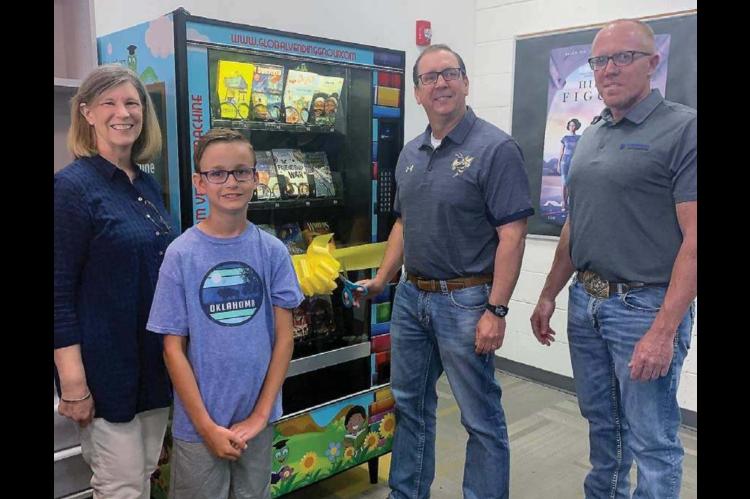
For longtime educator, school administrator and now librarian Kathy Kadavy, the concept seemed self-evident.
If you want to encourage students to be lifelong readers – a key determinant in not only their ongoing educational success but also their personal emotional and physical well-being – you don’t give them a fast food coupon or wrap them in a million dollar bill as a reward for reading.
You give them . . . a book.
Or rather, a coveted gold token that then allows them to select their own book from a giant, fully-functional book vending machine that’s been sitting in their school library all year.
That’s what got Kadavy excited about the Inchy the Bookworm book vending machine when she first saw a photo of one on an online educators and librarians group.
“The students who were using it looked like they were having the most fun they’d ever had,” she said. “When I saw kids getting that excited about books and reading, I knew I needed to do more research and see if it was possible to get one of the machines for Heritage.
“I am always looking for ways to get kids excited about reading, and this seemed like such a fun way to not only encourage kids to read but to allow kids to choose books they wanted and would be able to keep.”
Reading for reading’s sake. It’s a concept that warms the heart of every educator and librarian.
But the vending machine was a considerable investment, which made Kadavy consider the possibility of writing a Kingfisher Educational Foundation grant request to underwrite part of the cost.
“I knew the Kingfisher Educational Foundation is always looking for new, exciting projects to finance that are beneficial to students, and I thought the book vending machine really fit the bill,” she said.
KEF President David Blair said the nonprofit’s board of directors was immediately intrigued by the unique grant proposal.
“Last year I remember reading Mrs. Kadavy’s request for a book vending machine and she shared Kingfisher would be one of the very first school districts in the state to purchase the new idea,” he said. “At first, I wasn’t sure about it but the more the board and I talked about it, we believed it would promote reading.”
KEF agreed to underwrite half the cost of the machine, with the school district picking up the balance of the expense.
Kadavy said Kingfisher was the second Oklahoma school district to purchase one of the machines, only 150 of which had been delivered nationwide.
The vending machine has seen a lot of use since installed in the Kingfisher Heritage School library.
Kadavy selected the first award level at a number of words read that would be achievable by every student in her building, based on her research.
Students then have the option of earning more book rewards by achieving higher levels.
“By the time we left school last March, over 90% of the third and fourth graders had read 50,000 words or more and almost 85% of the second graders had reached that milestone so that became the first reward level,” she said.
The next reward level is 100,000 words, followed by 500,000 words.
“To date, we have given out 123 tokens and 36 students have already reached the 100,000 word goal.
“Last year at this time, Heritage students had read a total of 10,099,147 words and this year they have already read 12,465,528 words, so I think we have achieved our goal of encouraging children to read.”
Kadavy said she keeps an eye on which books are more popular when determining how to restock the vending machine and sees readers watch the books too as they work toward their goals, and usually have their eye on exactly which book they want to select next.
“The kids are really enthused!” she said. “Kids come in and window shop and report their progress to me every time they’ve read another book.
“I think one of the things that is truly exciting about this reward is that it is a reward that encourages more reading, rather than something that has no real connection to reading.”
Blair said the vending machine is exactly the type of unique classroom supplement KEF supports with its grant program, which is designed to pay for classroom enhancements that are beyond the school’s normal ability to finance.
Encouraging creative teaching methods has become even more essential during the pandemic, a fact recognized by local donors who supported KEF’s fundraising efforts like never before.
October is the month when teachers submit their new grant proposals, which are awarded around Christmas.
“Grant funds are to enrich student learning through innovative programs that stimulate thought and expand on the existing curriculum,” Blair said.
“Grant requests cover a wide range of ideas including materials and supplies, equipment, stipends for visiting instructors (artists/authors), field trips, academic fairs, such as the science fairs, and supplemental materials for an instructional program.”
“The Kingfisher Educational Foundation is an invaluable resource for teachers and students of KPS,” Kadavy said. “If a teacher has an idea about a program they’d like to implement, a speaker they’d like to have or a need they’d like to have fulfilled, the foundation is there for us.
“I’ve seen so many ‘extras’ funded by the foundation over the years that would have been difficult to finance without their support and those extras can be the spark that inspires a student to read, to write, to perform everything from musical numbers to science experiments.
“The foundation is one of the reasons KPS is one of the best schools in the state.”