
Warrior’s Rest footprint expanding in 3rd year, co-founder Brad Shepherd tells Lions
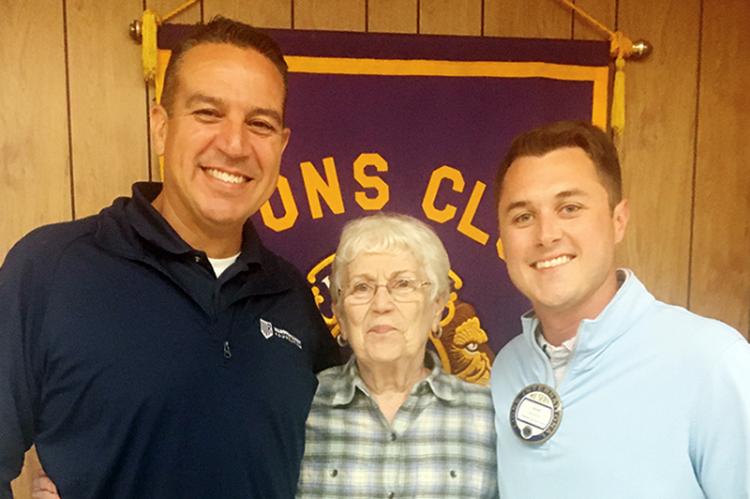
In existence just over two years, the Warrior’s Rest Foundation has already served more than 10,000 people coast-to-coast and even overseas, co-founder Brad Shepherd said.
The foundation, which was created to provide support to law enforcement officers and their families, has now expanded its reach to encompass all first responders, including firefighters and emergency medical personnel.
Shepherd, a 25-year veteran of the Oklahoma Highway Patrol who is now a trained crisis interventionist and executive director of the foundation, updated Kingfisher Lions Thursday on the foundation’s progress.
Along with Dr. Kathy Thomas, an Oklahoma State University-educated psychologist who’s gained a national reputation in trauma intervention, and other law enforcement colleagues, Shepherd began working on the idea for Warrior’s Rest in 2014.
“The idea was to help law enforcement officers navigate careers that are immersed in trauma,” he said.
Thomas has been a specialist in treating job-related trauma for emergency workers since the Murrah Building bombing in Oklahoma City, he said.
“She volunteered there with the intention of helping survivors of the bombing deal with the trauma and she ended up focusing on the first responders who were absolutely overwhelmed,” he said.
“So for the last 25 years, that’s been the focus of her practice.”
Shepherd cited recent national research that shows that 46.7% of firemen have considered taking their own life.
“That’s nearly one out of every two and the law enforcement numbers are only slightly less than that,” he said.
“Why are these noble and courageous people who serve us considering taking their own life? We think it’s the trauma they see every single day.
“Warrior’s Rest was created to come alongside these people to say I want to help you maintain yourself.”
In addition to connecting traumatized law enforcement and emergency workers with appropriate mental health treatment, Warrior’s Rest also trains peer support teams, so that local departments are able to continue helping their own employees.
Shepherd said his foundation has provided that training at departments across the country and – thanks to the ready availability of videoconferencing in the midst of the pandemic – internationally as well.
“The effectiveness of peer support is based on the fact that people in our profession are more likely to open up to someone who has been there,” he said.
Shepherd should know.
He went through his own dark period when he lost a partner earlier in his career with the OHP.
(After the Lions Club meeting, Shepherd elaborated on his situation in a conversation with the Times and Free Press: “My partner was killed in an operation that I wasn’t sent on. I suffered from survivor’s guilt that I wasn’t there to save his life.” He added that nine OHP troopers were killed in the line of duty during the course of his career and he’d worked closely with four of them in various capacities.)
“My partner’s death started a really dark chapter in my life that lasted about six years,” he told the Lions Club. “Outwardly, I was fine, but inside I was incredibly angry.
“That drives me to do what I do today and that’s the nature of peer support – being able to say ‘I’ve been there. I get you.’”
Shepherd said another pillar of his foundation’s service is to provide support to the spouses and children of officers and first responders, ensuring their safety and helping build stronger marriages and family units.
In response to a question about whether his foundation is seeing more officers suffering mental trauma and stress in response to this year’s rioting and the defund-the-police movement, Shepherd responded: “Yes and no.”
“Yes, in that more and more officers are stressed and disillusioned and no, in that instead of seeking help from us, dozens upon dozens are just leaving the profession,” he said.
“That’s sad.
“When people are in a traumatic situation and call 9-11, they are experiencing their very worst day,” he added. “But the fireman, EMT or law enforcement officer who responds to that call experiences that level of trauma over and over and over again.
“So if I am an officer showing up to help you on your worst day, and I’ve also been there for everyone else’s worst day, and you are upset with me and criticizing me, then I am not going to want to do this anymore.”
Shepherd reminded Lions Club members that Warrior’s Rest is a 501C(3) nonprofit corporation, and while some of its services are revenue-generating, it relies heavily on the generosity of donors to continue operations.
“We reach the three-year mark at the end of this year when we will be eligible for consideration for government and foundational grants, but right now we’re dependent on donations from individuals and businesses,” he said.
Donations can be made through the organization’s website: warriorsrestfoundation.org.
Shepherd was introduced by program chairman Annette Parham.