
Welcome to Public School 2.0
Education may look different, but won’t stop in wake of SDE order
Teachers will be teaching.
Students will be learning. It will just be done in a way – and on a scale – unprecedented in Oklahoma.
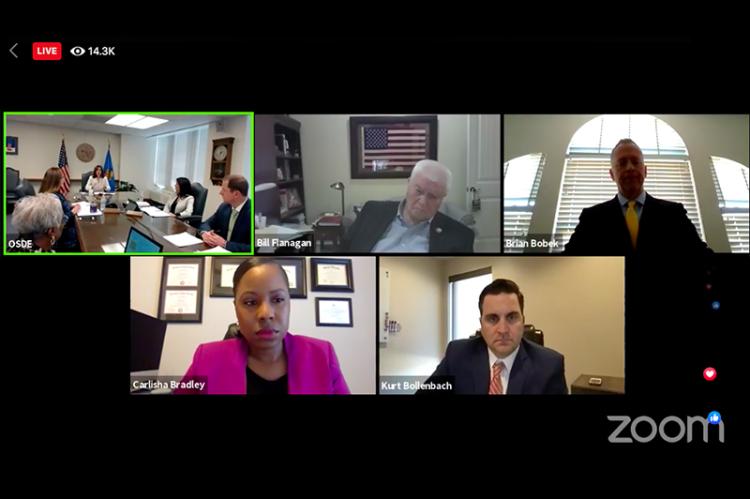
The State Board of Education Wednesday unanimously approved an order that implements a Distance Learning Plan to complete the 2019-20 school year for Oklahoma students without reopening school buildings. The approval comes as numbers grow for positive COVID-19 cases in the state.
The order means students and teachers won’t be returning to their school buildings this school year, but will finish it out at home.
“This is an unprecedented situation and it has required an unprecedented response,” said Kingfisher Superintendent Jason Sternberger in a letter to school patrons.
“We can still take care of Kingfisher’s students.”
State Superintendent Joy Hofmeister said she’s aware that the way Kingfisher, for instance, approaches distance learning may have to vary from how other districts do it.
“Distance Learning Plans will look different from district to district. Many districts have used online tools for some time and will be able to hit the ground running,” Hofmeister said. “Others have little connectivity and communities with little or no access to computer technology. I know the hard-working educators in our districts will pull together to make this adjustment to benefit all learners.”
School districts here began sending surveys to patrons last week to gather information such as the availability of internet access and devices (home computers, laptops, tablets, etc.) for each student.
That information was to be used by districts in forming their Distance Learning Plan and was also to be provided to the OSDE.
OSDE will provide distance learning frameworks and resources on its website (sde.ok.gov) in the coming days.
Local districts are awaiting survey results and that framework before finalizing their respective Distance Learning Plans. District leaders will provide those plans to OSDE and also ensure services continue for English learners and special education students. Those plans will be put
Those plans will be put into action beginning April 6.
“KPS is developing a plan to ensure your child will continue to have opportunities to learn and to grow academically, especially with parental support,” Sternberger said. “We will spend he next week planning for his effort and will share etails with your family as oon as they are available.”
Cashion Superintendent ammy Jackson said his istrict is also awaiting more nformation from the survey and will work to develop its plan.
“Although these are uncharted waters, a positive from this is that this will allow us to develop a more blended educational proram for the future when raditional school resumes,” Jackson said.
In Okarche, Superintenent Rob Friesen said disance learning goes against he district’s model, but he nd his staff will make the best of the situation.
“We feel pretty good bout our plan as of this moent and are just waiting to ee how it corresponds with what the state rolls out,” he said. “I really believe the only major obstacle is that our process is centered on daily interaction with students, which cannot be replaced in any way.
“To roll out a distance learning initiative goes against what we do. We do understand the necessity and we pray we will do the job in a manner that is benficial to our students.”
Crescent sent a letter to tudents and parents Thursay that laid out its plan, which will include instrucion four days a week from pril 6 through May 14.
“We are pretty fortunate rom a device standpoint. ur fifth-12th grades will have school-issued devices. am sure like everyone else, nternet connectivity will be n issue for some students,” rescent Superintendent art Watkins said.
OSDE is exploring how ederal assistance could help digital connectivity for some districts.
OETA, Oklahoma’s educational public TV network, will also provide help. In partnership with OSDE, OETA will broadcast instructional daytime programming for the state’s reK-12 students.
Watkins said his primary oncern is educating stuents in the most formative rades.
“How the elementary chool operates is probably he biggest question for ost people,” he said. “We re stressing that the teachrs need to interact with stuents as much as possible; just sending home packets f work or links to assignents is not acceptable. Our eachers have been really positive and are looking forward to the challenge.”
Lomega’s staff worked on its plan Thursday, said Superintendent Steve Shiever, and will do so again Monday.
He’s confident Lomega’s students will receive the proper tools necessary to learn.
“This is a community that sticks together in challenging times and we know this experience will be no different,” he said in a letter to patrons. For the graduating class
For the graduating class of 2020, each district will adopt a plan that establishes the assessment or assessments those students are required to take in order to graduate.
“For our seniors and their parents, we know it is an especially difficult way to end the year so abruptly,” Sternberger added. “We will do everything possible o figure out a way that the raduate can be honored publicly for all their years f hard work and success.”
The State Board on ednesday also took action n multiple waivers – rangng from school calendars o loosening current retrictions on funds – aimed t giving districts greater exibility to respond to the eeds of their students and ommunities.
Kurt Bollenbach: Tough times, tough measures
by Kurt Bollenbach
[Ed. note: Kurt Bollenbach of Kingfisher was appointed to the State Board of Education in April 2019 by Gov. Kevin Stitt. He agreed to offer his insights into the decisions required by the COVID-19 crisis.]
The last four weeks have been an entirely unexpected situation to be in.
In February, we were approving the updated science standards, and by March, we had to completely alter the delivery of education in the entire state due to COVID-19.
This pandemic is a reminder of the importance of providing a quality education to our kids. Educated researchers and medical personnel are who we all depend on to keep us safe in this crisis.
Being involved in state level decisions has given me a perspective for the challenges faced by our decision makers. I appreciate the individuals who reached out to me with their constructive two cents.
In general, superintendents and principals have been very positive and understanding that we must figure out a way to work with teachers, parents, and students during this bad situation.
Most seem very motivated to use creative ways to keep the numerous speed bumps that arise from being a roadblock to engaging students.
Also, I can’t express enough gratitude to the leadership of Superintendent Joy Hofmeister and the staff at the Department of Education.
Over the last few weeks, I have routinely received calls at 11 p.m. asking me to review the latest guidance, only to have the guidance need to be completely re-written the following day due to new federal guidance.
The SDE staff are tireless civil servants in the truestsense of the word.