
A Wretch Like Me
My Brother’s Keeper demonstrates value of residential, faith-based recovery
KT&FP Senior Editor
Brent Yoder knows a little bit about addiction and what it takes to escape the clutches of a substance or behavior that is destroying your life.
Yoder, 37, a 2000 graduate of Kingfisher High School, has been a men’s home director at My Brother’s Keeper, a residential, faith-based recovery center in Oklahoma City, for more than four years.
He is also a former drug dealer and opioid addict.
And, since Kingfisher is where he got his start in both, Yoder knows more than a little bit about things that go on here, and what an impact a local faith-based residential program like the one proposed by Frontline Ministries could make.
“The thing about it is that the people coming into a place like that would be coming out of the community,” he said. “When addicts are out there getting high, that’s when you really need to be concerned about them.”
“But when they’re in a place like this,” Yoder said from an office at My Brother’s Keeper, “focused on their recovery and working on developing a new way of life, that’s when the community benefits.”
Fruitful Ministry
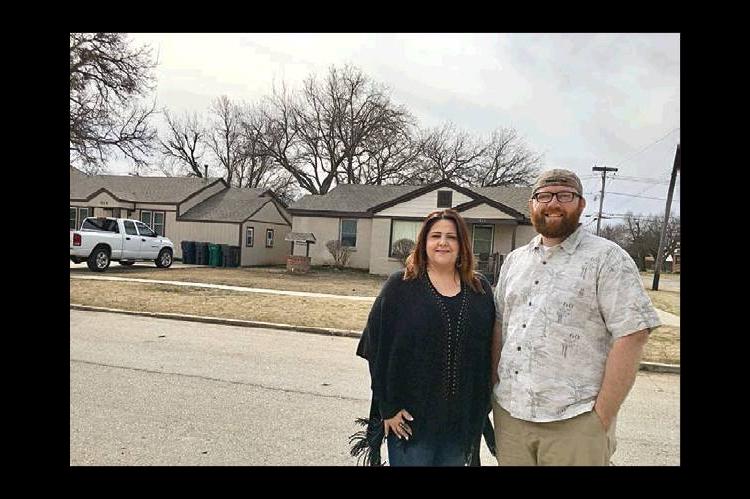
My Brother’s Keeper is located in a residential northwest Oklahoma City neighborhood on a campus situated very similarly to the Journey Center Sober Living Homes planned by Frontline Ministries on Erwin Avenue.
The MBK men’s living quarters are located in three modest houses lined up in a neat row across the street from Word of God Church, their sponsoring ministry, which is under the direction of Phillip and Melba Castillo.
Around the corner is another house which serves as sleeping quarters for the women.
The Castillos’ daughter, Lisa Bartodej, who also is active in the ministry, said that in its 10 years at the current location, My Brother’s Keeper is having the opposite effect on the surrounding neighborhood that Kingfisher neighbors fear for the Frontline project.
“This was an open drug neighborhood and my parents have been slowly buying up the old drug houses and fixing them up to become part of our campus,” she said.
Even so, Bartodej said MBK had to overcome some initial community resistance.
“That all went away when they actually saw the fruits of what we were accomplishing here,” she said.
Though on the small side by typical family standards, the men’s homes contain beds for 37 men divided in groups of 14, 13 and 10 among the three houses.
The women’s residence houses 10-12 women, Yoder said.
Yoder led an informal tour through one of the men’s homes Thursday.
Sleeping arrangements involve stacks of bunkbeds to take advantage of all the available space in bedrooms, but the living area and kitchen offered room for group prayers and meals and the entire house was neat and tidy.
At 10 a.m., its occupants were long gone. Yoder said following a 5:30 a.m. wakeup, residents are engaged in prayer and personal study until 6:30 a.m., when they do their household chores, followed by breakfast at 7:30 a.m.
By 8 a.m., residents are across the street at the church, where they are involved in classes and work projects.
Shortly after 10 a.m. on Thursday, men were bustling about the main church building, sweeping, mopping and generally sprucing things up.
Their Daily Bread
To outsiders, MBK is probably best known by its banana nut bread and tamales, sold regularly by crews of residents traveling in MBK vans to surrounding towns.
Yoder led visitors through the shiny clean commercial kitchen, certified and regularly inspected by the state health department, where the food is prepared to exacting standards.
The food sales help cover operating costs for MBK, which charges nothing to its participants for the year-long program.
But more than that, Bartodej said selling the food items is an important part of community reintegration for MBK participants.
“They’re not just selling the bread, they’re learning to sell themselves and interact with all kinds of people, just like they’ll have to do when they get out,” she said. “It’s also an opportunity for discipleship.”
Following the one-year residential program, graduates can move to a nearby transition home, where they can have their own cars for the first time and find outside work.
While less strict than the recovery houses, the transitional home still has rules such as regular curfews and no visitors of the opposite sex.
Time spent in the transitional home before exiting the program is left up to each participant, but many have chosen to stay for months or even years, Yoder said.
The difference between MBK and other faith-based programs and secular treatment centers is the recognition that achieving sobriety is just the first step in a long polishing process, Bartodej said.
“People come in here thinking they have a drug addiction problem and then when they get to sobriety they see all the other problems that are behind that,” she said. “That’s what they work on here.”
The total reliance on God and prayer is not for everyone and the program has its share of turnover, but for those who are serious about changing their lives, (“whose hearts are right,” Bartodej said), real change happens.
Yoder’s Journey
“I sold drugs when I was younger and became addicted to that lifestyle – nice cars, women, the whole bit,” he said.
Yoder thought he’d escaped that destructive life once at age 22 when he stopped selling drugs, started dating the daughter of a local pastor and began working towards his own career in ministry.
“I went to SNU (Southern Nazarene University), got married to the preacher’s daughter and then fell into a thing where I needed to provide for my family with a car, a home, all those things,” he said.
He interviewed at a church, which he described as “a white church in a black neighborhood with no outreach, no attempt to connect to the community at all,” he said.
The experience soured him and tested the bounds of his fragile recovery.
Yoder’s marriage ended in divorce and “I went back to the things I did when I was younger, trying to mask the pain.”
That’s when Yoder heard from Leo Padilla Jr., an old friend from his drug selling days.
“Leo and I were close, he was my go-to guy,” Yoder said. “He kept telling me about this place called My Brother’s Keeper and how it changed his life.
“I was not interested and did not want to hear about it, but my dad would not forget about it and kept telling me I needed to go.”
If for no other reason than to “get people off my back,” Yoder finally picked up the phone and called MBK.
“The person who answered said they had a bed available right then so come on,” he said.
Yoder said part of the difficulty of walking away from opioids is “you become physically sick when you stop taking them, like you have the flu. That’s one of the the things that always pushed me back into using every time I tried to quit.”
When the staff at MBK prayed over him when he first arrived, Yoder said those flu-like symptoms never developed.
Unfortunately that wasn’t the end of Yoder’s urge to walk away from the program.
“After about three days, I started sobering up and realized what I was facing – looking at a year in this place – I thought ‘what am I doing here?’” he remembers.
Compounding his pain was the fact that his ex-wife had moved to a neighborhood just 15 minutes away, but he wasn’t allowed to see her because of the program’s restrictions against any outside contact for the first month.
“I just started praying and said, ‘Look, God, you gotta help me if you want me to stay here,’ and I felt like he was telling me ‘just give me what you’ve given me,’” he said. “So that kept me there another three days, and then after the first week, I’m still getting that message, so that turned to two weeks, and then a month and then two months and after three months, I decided I could make it.”
Not only did Yoder survive the year, but he is now a member of the ministry team and men’s house director, a position he’s held for four years.
He has his own place and a restored relationship with his daughter, who visits frequently.
“I never would have seen it happen if I hadn’t come here,” he said. “That’s one of the exciting parts of this ministry – being able to restore these broken men back to their families.”
Kingfisher Version
Frontline Pastor Debbie Burpo said that while the Journey Center planned by her ministry will have elements in common with MBK – primarily its faith-based, Christ-centered, approach and similarly arranged residential campus – it’s not identical.
For one thing, the Kingfisher program is employing the Adult and Teen Challenge curriculum, a proven combination of Biblical teaching and life and personal skills training.
For another, all participants in the Kingfisher program will be voluntary admissions, not court-ordered.
Yoder said that while he only recalls three or four times that drugs were brought into MBK’s homes in the four years that he’s been there, all of those problems arose among court-ordered participants who did not want to be there.
“When you have people submitting voluntarily, who are genuinely interested in making changes in their lives, they are too busy working on themselves and their issues,” he said. “I don’t see that being a problem with what they’re trying to do in Kingfisher.”
Kingfisher commissioners are scheduled to vote on the fate of the zoning and conditional use permit requests required to allow the Journey Center to move forward at the 5:30 p.m. March 11 meeting at City Hall.