
6 takeaways from IG report
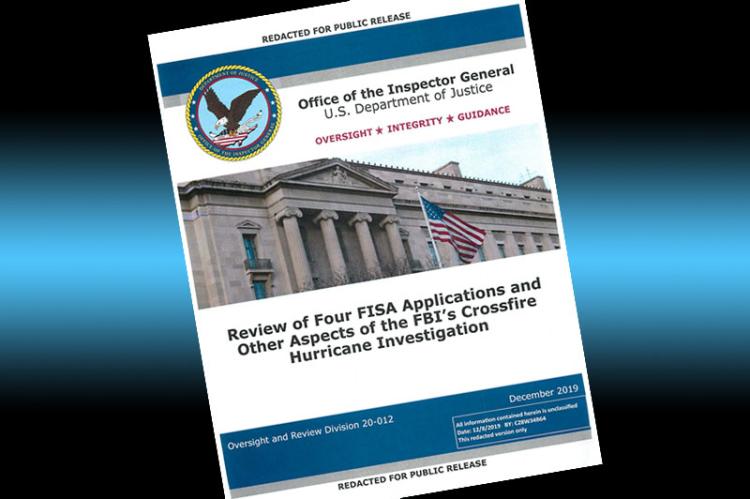
The Justice Department’s in-house watchdog released a 476-page report Monday that criticizes some of the FBI’s actions in beginning an investigation of the Trump campaign’s connection with Russian election meddling, but does not conclude that political bias drove the agency’s probe.
Inspector General Michael Horowitz’s report does answer many questions and verifies some suspicions about the initial FBI investigation, dubbed Crossfi re Hurricane.
Attorney General William Barr, Horowitz’s boss, issued a statement Monday saying that the report shows the FBI’s “clear abuse” of the process for obtaining warrants to spy on Americans.
Horowitz is scheduled to take questions Wednesday from the Senate Judiciary Committee on his report, which arrives as the House Judiciary Committee drafts articles of impeachment against President Donald Trump.
Here are six key takeaways from Horowitz’s report.
1. Surveillance BroaderThanInitiallyThought
Americans already knew the FBI used surveillance to keep tabs on two Trump campaign advisers. Initially, news reports made it clear that foreign policy advisers Carter Page and George Papadopoulos were under surveillance.
The IG report states that two others also were subject to FBI spying: retired Army Lt. General Michael Flynn, a high-level campaign adviser who would serve less than a month as Trump’s first White House national security adviser, and onetime Trump campaign chairman Paul Manafort.
The IG report concludes that “the quantum of information articulated by the FBI to open the individual investigations on Papadopoulos, Page, Flynn, and Manafort in August 2016 was sufficient to satisfy the low threshold established by the [Justice] Department and the FBI.”
In May 2017, about four months after Trump became president, then-Deputy Attorney General Rod Rosenstein appointed former FBI Director Robert Mueller as a special counsel to complete the investiga-
[To be continued Sunday]