
Sheridan hunt describes area before statehood
VIEW from behind the plow - -
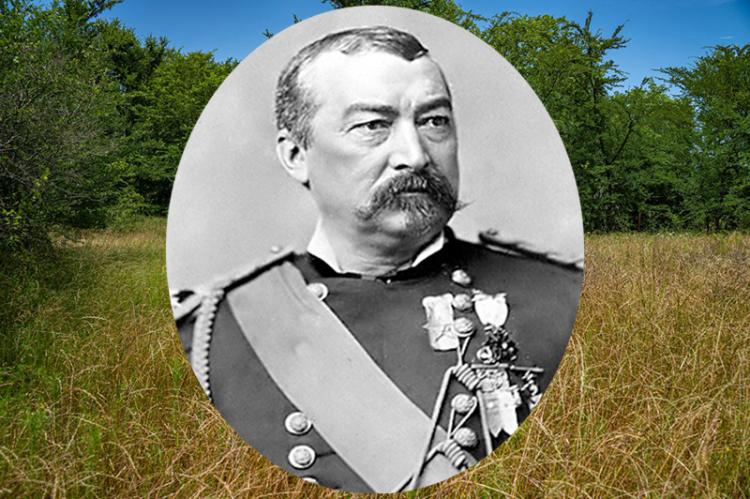
Our son, Michael, brought us by a copy of a booklet, “Canadian River Hunt,” about a hunting trip taken by Gen. Phil Sheridan of Civil War and frontier fame and some of his friends in this area of Oklahoma in the late 1800s.
Psst. Don’t tell anybody but they were shooting turkeys out of their roost trees. That would be illegal today.
But General Sheridan was not an out-and-out game hog. He is credited with aiding in establishing Yellowstone Park as a game refuge later.
A journal of the hunt, which lasted from the end of January, 1878, to March 1, 1878, was kept by Gen. William E. Strong, including how many games of euchre (a card game) the participants played when they weren’t hunting. Strong presented the journal to Sheridan as a Christmas gift in remembrance of the hunt on the North Fork of the Canadian and Cimarron rivers.
The 68-page journal includes copies of hand-written notes from Sheridan to Strong as well as drawings. The journal survived for almost a hundred years until Tonkawa native Fred P. Schonwald, a businessman and student of western art and Americana, purchased the manuscript from a San Francisco dealer in 1956.
The journal has been printed (1,050 copies) by the University of Oklahoma Press in Norman
Schonwald was born at Tonkawa, along the route Sheridan and his guests took on their way to hunt. He wrote the foreword to the document, commenting that the hunters found turkeys by the thousands, fat deer, antelope, ducks, prairie chicken and quail.
Schonwald commented:
“It is a picture of active men at play and of a still wild Oklahoma, its river valleys lush with tall grasses, its cloudless skies pale blue in the midwinter sunshine.”
We don’t intend to denigrate Schonwald’s foreword, but the journal lists quite a few hunting days lost due to rain.
Sheridan’s military friends on the hunt besides Strong, included Generals George Crook and William D. Whipple, along with several lesser military personages, who are mentioned by name.
Getting special mention and a line drawing in the volume was the guide for the hunt, Army Scout Ben Clark, whose talents as an outdoorsman impressed Strong.
He commented on his ability to find his way back to camp through the then wilderness even in the darkest nights and in the rain.
The hunting party met in Wichita, Kan., with the honored guests, arriving from their home bases by train, then taking horse- or mule-drawn military vehicles to the hunt sites.
Strong commented on Sheridan’s insistence that their hunting camps had the organization of an Army operation, the tents all in a row and sharp schedules maintained.
The foreword begins with these words:
“At half past four, we raised the top of a rounded butte, and in a little valley below us, within easy rifle shot, lay our encampment, and in rear of it nearby, were pitched the teepees of 50 or 60 lodges of Arapahoes, who had come in since our departure in the morning. We were half an hour behind the dinner hour, but were first in. As we dismounted, General Sheridan said, ‘Hurry up Strong and eat your dinner I have discovered an immense turkey roost and will give you rare sport tonight. …
“The roost was an immense one. I should judge it was a quarter mile in width, by a mile or more in length, lying on both sides of a creek.
Clark’s mention piqued our interest so we checked him out on the internet.
It reported he was born in St. Louis, Mo., Feb. 2, 1842, and at the age of 13 traveled to Fort Bridger, Wyo., where he served as post courier.
During the Civil War, Clark served with the 6th Kansas Cavalry, which patrolled the borders of Missouri, Arkansas and the Indian Territory. After the war, he managed pack trains for the Indian traders and married a Cheyenne woman named Toch-E-Me-Ah, known as Emily. They had a daughter named Jennie in 1872, but who died at Lawrence, Kan., in 1893. Emily would die in January of 1873 when she was hit by a stray bullet fired during a drunken brawl … at Camp Supply.
After the death of his first wife Clark married a Cheyenne woman named Red Fern. Their marriage resulted in the birth of another daughter, Emily. Red Fern died in 1880 and later that year Clark remarried yet again to Moka (also known as Bull Horn or Little Woman). Ben Clark was twenty years her senior. The couple had twelve children - of whom five had died by the turn of the century.
Clark became quite fluent in Cheyenne and Arapaho (Cheyenne in particular) and sign language (and) was respected by both Indians and whites. Known to the Indians as “Red Neck,” from the color of his burned skin, he was well trusted by them and often served as their intermediary.
He signed on as an army scout in 1868. Clark served as chief of scouts for the Sully expedition and the Custer expedition in 1868 before assignment to General Sheridan’s staff. He became a valuable asset to General Phillip Sheridan and Lt. Col. George A. Custer during the winter campaign of 1868-69. As Custer’s chief scout, Clark and three other scouts reconnoitered the vicinity of Chief Black Kettle’s village on the Washita River and reported the precise information regarding the terrain to Custer, who could then formulate his attack plan.
(Note: The Washita battle site is located immediately west of Cheyenne, easily accessible and well worth the trip.)
Clark is credited with telling Custer that Captain Edward Myer’s command - in total disregard of Custer’s direct orders - was shooting into groups of women and children. He was dispatched to order Myer to cease at once and instead take the woman and children as prisoners.
Ben Clark was appointed post interpreter at Camp Supply in 1869 and the same position at Fort Reno in his later years.
On May 6, 1913, Moka died and was buried at the Fort Reno Military Cemetery. Despondent over the loss of his wife and suffering from paralysis, Benjamin H. Clark ended his life on July 24, 1914, by a gunshot to the temple. He was laid to rest near Moka.
We got off the subject but we would recommend the “Canadian River Hunt“ as a quick and easy read for anyone interested in how this area looked before the run of 1889 which opened the Unassigned Land to settlement.