
VIEW from behind the plow
‘I Chose Freedom:’ Cause for reflection
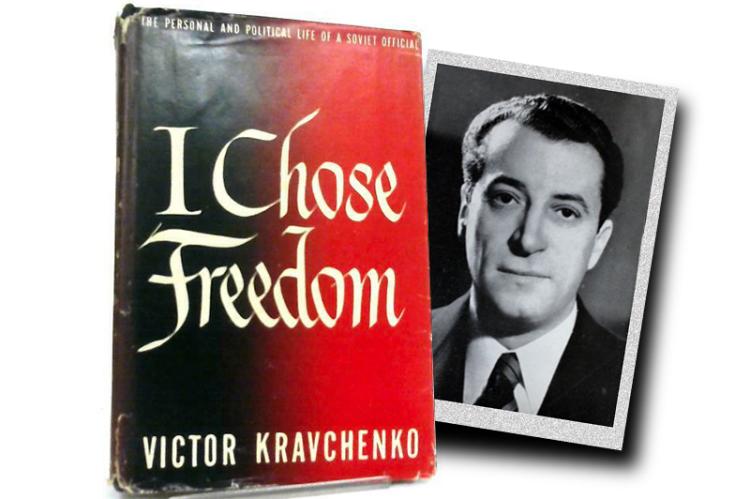
Dr. James Gerber brought by a book for us to read, “I Chose Freedom,” by Victor Kravchenko.
Kravchenko, a native of the Ukraine, grew up during the time of the Communist take-over of Russia and satellite states, and became a communist at a young age.
He defected to the U.S. during World War II while serving as a Soviet emissary to the United States.
His book, written in 1948 and which became a best seller in both the U.S. and Europe, tells of the realities of life in a communist regime.
He wrote that he kept his eyes and his mind half-closed as he rose in the ranks of communism, shutting out much of the wrongdoing he was exposed to as he climbed the Communist ladder.
It is a book every American should read, especially those younger citizens who say they would prefer to live in a socialist country.
We don’t know that we feel like thanking Doctor Gerber for the loan of the book.
It is one of the most depressing books we have ever read, ranking right up there with “Harvest of Sorrow,” by Robert Conquest, which dealt with the collectivization of Soviet peasants.
We can read Kravchenko’s book a little while then have to put it down and do something else, to give our mind (and emotions) a rest.
Kravchenko’s first-hand reports of small children being separated from families during the collectivization process are heart-breaking – little kids 10 and under who wandered about begging for food to keep them alive. They were termed “orphans.”
His parents took in one of the little “orphan” girls and a family he met when he was assigned the job of going to a village and forcing the farmers (Kulaks) to bring in their grain for the dispersal to others took in a little boy.
Their stories, as retold by Kravchenko, were almost identical.
They said their fathers were repeatedly beaten to force them to give up grain they didn’t have, then after the dads butchered farm animals they had raised to help feed their families, the local Soviet officials GPU (Secret Service) arrested them for butchering them, an illegal act under the regime without Soviet permission.
Neither of the fathers had agreed to become communist.
The small farmers in the villages where Kravchenko and fellow team members were sent to bring in the harvest were in desperate straits because of drought and the removal of any individual authority, hence incentive, to produce as they once did. Kravchenko realized that the “revolution” was not doing for the people what idealists such as himself had expected (they were worse off than under the tsars) and he made attempts to help them while still meeting party protocol.
One tyrannical system had been replaced by another with government bureaucrats taking the place of former royal aristocrats, living plush lives while common people were starving to death, being shipped in cattle cars to Siberia, or other labor camps or executed.
The collectivization of the farmland (moving peasants from their homes – many of whom had owned land under the previous regime) was seen by the communist leaders as vital to the completion of the revolution. The leaders feared land-owning peasants would join an opposing army if Russia was attacked.
A recurring theme throughout the book was the demand that everyone adhere strictly to the rules that came from on high, even if they made no sense. This resulted in waste (overseers on jobs knew they had to follow orders from technocrats hundreds or thousands of miles away or face dire consequences – from dismissal and humiliation to loss of life), frustration on the part of both managers and laborers (managers because their hands were tied, preventing them from taking actions necessary to complete projects while also meeting party dictates) and workers because they were forced to live in subhuman conditions – lack of food, vermin-infested quarters (bedbugs, mice and rats in their leaking barracks, lack of heat and lack of adequate bedding and clothing).
Communism’s and socialism’s animosity toward religion – Christianity in particular – is explained in the book.
Noting that communist leaders sometimes adapted to new situations, with which it did not agree, in order to “build bases for new advances.”
Kravchenko explained the Soviet policy.
He quoted them regarding Central Committee theory:
“The most galling compromises made necessary by war was in relation to religion.
“The clergy had been permitted to write and enabled to publish a book called ‘The Truth About Religion in the U.S.S.R.’ in which they signalized reconciliation with the Soviet system. Though few people among us attached too much significance to the book, we heard that it created a sensation abroad.
“With a view to directing our thinking (Pavel) Mironov (military hero of the Soviet Union), called the party activists to his office.
”’Comrades,’ he explained ‘we have had to make some concessions to believers, especially as so many of the Red Army soldiers are drawn from backward villages where religion still has a considerable hold. Also, the enemy is making use of our anti-religious attitudes for propaganda purposes and the improved relations with the Russian Church cuts the ground from under them. Then there is another important consideration: our armies soon will be moving into Slav countries which have not had the benefit of a Communist education. …
‘Our new religious policy will be valuable in smashing the anti-Soviet propaganda of the Roman Catholic, Lutheran and other religious groups. … We must, in the next period, take a broad view of the problem. We have the chance to draw the Orthodox Church in other countries closer to Russia and make Moscow the new Rome.’
“‘But Comrade Mironov,’ one of the men present spoke up, ‘isn’t there a danger that the new generation, which will take our place, may be spoiled by religious superstition.’
“‘Don’t worry on that score,’ he replied smiling. ‘‘There is neither soil nor sap on which religion can feed in the U.S.S.R. After all, the press, theatre, radio, schools, literature, all the forces that are of the mind are in the party’s sole control….
“‘Remember the Church is separated from the state – and the schools are in the hands of the state. The Comsumols, you may be sure, will be stronger than the priests. Are we such idiots that we will turn over the new generation to the priests.’”
Earlier he had pointed out that any individual with religious inclinations would never make a career as a communist.
“‘If he is not on our side spiritually and politically, there is no place for him,’” Kravchenko recalled.
We have yet to finish the book but we plan to keep plugging away. It is far too instructive, explaining the tyrannical mind, not to finish.
Thomas Jefferson warned early on that the nature of government is to increase its power to the detriment of citizens.
Others have reminded time and again that socialist (centralized) governments never fail to evolve into dictatorships.