
Extending tax ‘not a lot to ask’
That was the message of a majority of citizens during a community discussion Thursday as many voiced support in providing KFD with new building ‘they need’
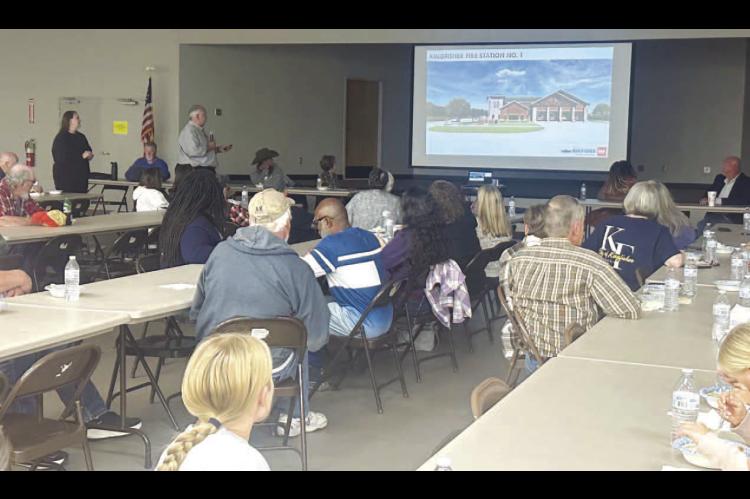
As they dined on bowls of hot chili, dozens of Kingfisher residents appeared very warm to the idea of continuing a sales tax to pay for a new home for the Kingfi sher Fire Department.
About 100 people were on hand Thursday night for a community discussion at the Kingfisher County Fairgrounds Exhibit Building.
City leaders set up the public forum to inform voters of the obstacles facing them and architects as they try to plan for a new building, what has caused the obstacles and potential fixes to the problem.
The most likely scenario is extending a one-half cent sales tax for another 10 years, which officials said would not only cover the funding gap to build a proper department, but also allow the city to handle some of infrastructure needs, which was the intent when the tax was first passed in May 2021.
A majority of the audience members showed support for such a scenario.
Among them was retired Oklahoma Highway Patrolman Bill Reitz, who said he was a paramedic for eight years before joining the OHP.
While Reitz said he doesn’t live in city limits and can’t vote on the sales tax, he and his wife, Dawn, own a successful business in city limits, The Quilt Lady.
“I think a half-penny is not a lot to ask to get what our firefighters need and what we’re going to need for 50 years,” Reitz said, setting off a round of applause among those in attendance.
Reitz wasn’t alone. “You’re not building this building just for the firemen,” added Katie Schroeder from the audience later in the meeting. “You’re building this building for the City of Kingfisher and for everyone that needs these services, so own this.”
Again, more applause. That was a welcome sound for city officials on hand, which included City Manager Jim Thomas, Mayor Geoff Covalt, Vice Mayor Jeff Wittrock and Commissioners Dawn Taylor, Kyle Mecklenburg and Debbie Burpo.
Also providing input on the evening were Fire Chief Ryan Gibson as well as Tony Stewart, the recently-retired chief.
Thomas sought out the meeting to provide information to community members as well as receive input.
He told those in attendance of the issues planners have faced since the tax was passed.
When passed by a 15966 vote, it was projected a new department would cost about $5 million and the tax would bring in just over $8 million over the 10 years, which would allow for other infrastructure and street improvements.
However, noted Ray Holliday of BRW Architects, Inc., the firm designing the new facility, as the city began to collect the new sales tax, construction costs began to skyrocket in a post-COVID world.
“Those construction costs jumped and they haven’t come back down,” Holliday said as he showed a chart on a projector screen.
BRW has designed hundreds of fire stations nationwide and currently has projects going in six states.
Holliday showed another chart displaying the average cost per square foot to build fire stations over recent years. According to the figures he provided, that cost has jumped more than 46 percent since 2020.
That average is now $667 per square foot, according to his chart.
When Kingfisher passed the sales tax, it was estimated to be about $500 per square foot.
Thomas said after being hired, he realized the department only planned a building of 10,000 square feet, which is only 2,500 more square feet than the current building.
In discussing those plans with Stewart, Thomas said it was determined that the planned facility also wouldn’t be large enough for current staff and equipment, much less projected growth.
Thomas and Stewart toured several other facilities across the state and eventually settled on what they felt was adequate for Kingfisher, which was about 16,500 square feet.
Added square footage and rising construction costs pushed city leaders to the point they realized the projected $8.2 million wasn’t going to cover the cost of the fire station.
So, as Thomas and others relayed at Thursday’s meeting, they delved into several options, many of which were discussed during a special meeting held in late August.
One option was to scale back the project. Holliday provided the city with a base scheme, which would cost about $500 per square foot.
It included lower-grade materials, some of them residential grade. It also didn’t include a direct capture exhaust system or generator.
The “better scheme” included those essential items, other commercial- grade materials and was estimated to cost about $580 per square foot.
The difference is about $500,000.
Keith Boevers is a retired Kingfisher County OSU Extension educator and was heavily involved in replacing the buildings at the county fairgrounds, including the one hosting Thursday’s meeting.
“This building was built in 1993 and it uses commercial products in it,” he said. “We’ve had very few problems with it; very little replacement.
“Your commercial products are going to pay for themselves in the long run whenever you build this (fire station),” Boevers continued. “Sometimes you’ve got to go ahead and invest in the future and have a 50year product.”
Said Thomas: “We want to build something that will stand the test of time.”
“Yes, you need to,” said Boevers, which drew more applause.
However, the projected income from the 10-year sales tax is going to leave the city about $5 million short of what the facility is now projected to cost.
Thomas pointed out that he has requested a $2.5 million federal appropriation and was recently notified that his request did make the first round of cuts.
However, he said, he won’t know the fate of those funds until at least after next week’s election and possibly as late as next year.
Should Kingfisher be awarded those funds, Thomas said the entirety will go toward the fire department.
But that still doesn’t cover the funding gap.
Mecklenburg said it’s up to the citizens to decide to cover that divide or have those in charge work within the budget that will be provided by the current sales tax.
“We’ve either got to fit the project in the budget we have, which means the size (of the building) decreases, some of the things inside the building are not exactly what everybody wants and it may not be a 50-year building,” Mecklenburg said. “It may be a 25-year building.”
The other option? “Or you go back to the citizens, who are paying for it anyway, it’s their money and you get their opinion,” he continued. “And you say, look, we are not going to have enough money within this budget we originally thought we were going to have to build the facility these guys need. It’s up to you guys to tell us if you want us to stay within that original budget or do you guys want to go ahead and add to that budget and build that facility the way these guys need.”
Covalt echoed a lot of the same sentiment and made note that when citizens passed the sales tax, the primary goal was to get a new fire station built in order to replace an outdated, 50-year-old structure currently in use.
“They needed it a long time ago. They do a tremendous service here. It is needed and you voted on it,” Covalt said.
“We’re going to deliver that.”
By meeting’s end - and after judging the temperature of the room - Covalt felt comfortable in saying the city would likely seek an extension of the sales tax.
“We are going to go out to a vote to be able to extend that and we would appreciate your consideration regarding this,” he said.
In a talk with Kingfisher Lions Club members earlier in the day, Thomas said the earliest they could call for an election would be January or February of 2025. The current tax runs through 2032, meaning an extension would push the half-cent sales tax to 2042.
Once that election is held, the city will know what it has to work with for the new department. Thomas said the plan is to go out for bid in April 2025 and “we hope to start construction in June with completion about 14 months after that,” he said at the Lions Club meeting.
Gibson concluded Thursday evening’s meeting by going over the floor plans for the new department and explaining why each area was needed.
“We’re not asking for a lot,” he said.
Holliday concurred when he addressed the group earlier in the meeting.
“The city and the fire department have been very responsible and forthcoming with their needs,” he explained. “They have not wanted anything outlandish.”