
The Jail that WPA Built
‘Ultra-modern jail house’ built against backdrop of other advancements
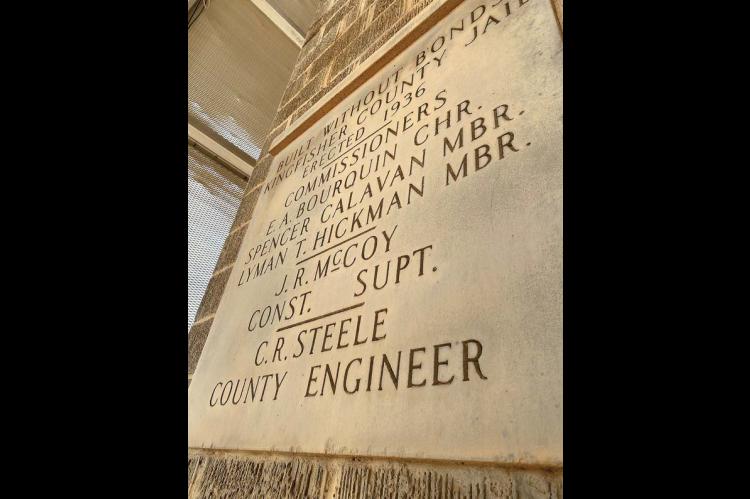
The mid 1930s were a period of amazing transformation in Kingfisher County, a still largely rural area that sprang up from the open prairie less than 50 years previously.
A massive rural electrification project brought electric lights and appliances to area farms.
The Oklahoma National Guard Armory was completed, Memorial Hall was air-conditioned, two new movie theaters and a bowling alley were opened and construction began on the Highway 33 underpass east of Kingfisher.
And the Kingfisher County Jail was completed as one of the last Oklahoma projects of the Works Progress Administration, President Franklin Roosevelt’s New Deal employment program that was gradually defunded by Congress beginning in 1937.
A search through the archives of the Kingfisher Times and Kingfi sher Free Press (still separate weekly publications in the 1930s) turned up interesting information about the jail project.
Work Order Issued
Under the headline, “Modern, New County Jail To Be Started Soon,” the Kingfisher Weekly Free Press reported July 23, 1936, that the district WPA administrator notified county commissioners that a work order had been issued for the jail, to be erected on the courthouse grounds.
“The building will be two stories with a full basement and will be built of cement brick, with the face of the brick tinted and waterproofed,” the article read.
“The cells will be of tool-proof steel, as near escape proof as can be constructed. There will be about 30 cells for men, a women’s ward and a junior ward.
“Besides the cell blocks, there will be a jail kitchen and dining room and quarters for the jailer.”
Cost of construction was estimated at that time at $41,000, with $11,000 to be furnished by the county, derived from a 1-mill levy approved by voters for that purpose.
(Ed. Note: Previous accounts erroneously put the cost at $5,800, which actually was the price paid for the steel cell blocks only.)
The jail eventually was completed at an estimated cost of $35,000 and replaced the original jail in the 400 block of North Main Street, which was more than 30 years old and had been condemned by the state fire marshal.
Vote No – Pay As We Go
Kingfisher County voters were stubbornly resistant to bond issues at that time, with opponents successfully using the slogan “Vote No – Pay As We Go” to defeat two such initiatives.
In an editorial published in the Oklahoma City paper and reprinted in the Kingfisher Weekly Free Press, People’s National Bank president B.C. Brigham opined: “We are building a new jail with WPA labor and funds of our own. But we did not vote bonds, we made an extra levy this year to pay our part of the cost and, when the building is finished, it will be free of debt.”
The local newspaper reported that the jail broke ground Monday, July 27, 1936, with 29 men working under supervision of a construction superintendent who had been moved from the nearly completed armory.
“The building will be constructed of fine materials and when completed will be an ultra- modern jail house, and a fine looking building,” according to the article.
The full basement was to include a number of vaults for the purpose of storing county records, while the first floor would contain a jailer’s quarters, office rooms and a cell block for “overnight or short-term prisoners.”
The second floor would contain the main cell blocks, kitchen and mess hall.
Other WPA Projects
The jail wasn’t the county’s only WPA project currently under construction. Others included farm to market roads, culverts, bridge approaches and the armory, where overhead doors were all installed and “work very slick indeed,” according to the newspaper.
The jail started with excava
- tion of the basement and by Aug. 20, 1936, “concrete footings are all poured and the form building is well under way,” the newspaper reported.
Coincidentally, Sheriff Ed Martin and his wife were among a number of local residents reporting the sighting of a meteor that hurtled through the sky over central Oklahoma in August 1936. Several residents noted hearing an explosion between Kingfi sher and Loyal when the meteor disappeared, which brought two Fort Worth astronomers to town to investigate.
If it did fall to earth, rather than disintegrate in the atmosphere, the meteor’s final resting place was never discovered.
Bricks Made on Site
At the end of August, bricklaying began at the jail. The concrete bricks were made on site via a “brick machine” that produced 2,000 bricks per day.
By Sept. 3, when a tornado northwest of Kingfisher demolished a hay barn, a two-story house and a chicken house and killed two of George Christian’s sheep, more bricklayers were reassigned from the armory to the jail project.
Meanwhile, the motion picture booth was removed from the Memorial Hall auditorium and 50 seats were added in its place.
The building’s basketball court was refinished with three coats of bakelite varnish, with plans to host spring basketball tournaments for county schools.
The Dover-Loyal bridge, another WPA project, was completed in September as the jail work was delayed while awaiting the arrival of tile from Arkansas.
Armory Formally Dedicated
On Oct. 26, 1936, the completed armory was formally opened, with a number of state dignitaries attending an open house, dinner and dance, which ended at midnight with the playing of Taps.
Constructed at an estimated cost of $40,000, the armory was the first of 51 in the state to be completed and dedicated out of a total of 125 in the entire country.
The next week, sheriff’s deputies intercepted a coupe traveling through the county and confiscated the 167 pints of bootleg whiskey it was carrying. Although ratification of the 21st Amendment officially ended Prohibition in 1933, Kingfisher was still a dry county in 1936.
All outside work on the jail was completed by mid December 1936 and “as soon as the inside work can be finished and cells etc. installed the building will be ready to receive those who have run afoul of the law,” the Free Press reported in its Dec. 17 edition.
The construction superintendent confidently – but mistakenly – asserted “his work will be completed within a month or so.”
In late January 1937, county commissioners contracted to purchase “steel felon blocks” from Southern Prison Company of San Antonio for $5,800.
“The contract covers exterior walls of the cell blocks, which will be of toolproof steel construction.
“The federal government, through the WPA, will furnish interior cell partitions, doors, transom plates, corridors, shower stalls, door locking and operating devices, and certain other items,” the Kingfisher Times reported.
Meanwhile, a Kingfisher Chamber of Commerce committee received assurance from the state highway commission and state legislators that the estimated $200,000 Highway 33 underpass construction in Kingfisher would begin before the end of the fiscal year.
The paper also reported in that issue that three Kingfisher County residents – Roy Davis, Frank Bushy and Deafy Fletcher – were among 500 actors appearing as “mounted Indian warriors” in the Cecile B. DeMille production of “The Plainsmen.”
And Sheriff Martin and his deputies continued their anti-liquor campaign with the destruction of 41 gallons of moonshine and 708 pints of liquor which had been accumulating in the vault of the sheriff’s office.
Rural Electrification Begins
A pole-raising ceremony in May signaled the beginning of construction on the Consumers Rural Electric Company’s rural electrification system, initially to consist of 289 miles of electric lines serving 890 customers.
A June 1937 tour of WPA projects in Oklahoma’s sixth district included stops at the jail, the armory and park improvement projects.
Grading, drainage and graveling of Highway 33 from Kingfisher east to connect with the pavement west of Guthrie was included in the 1937 program of the state highway commission, in addition to the construction of the underpass.
Prisoners Move In
Although the jail wasn’t entirely completed, the 11 county and city prisoners held in the old jail were transferred to the new facility without fanfare the first week of June 1937.
(Months earlier, Sheriff Martin had promised a public tour before prisoners arrived, but if an open house ever happened, it was not reported in the newspaper.)
The sheriff’s office remained in the basement of the courthouse until sometime later.
Once the prisoners were transferred, “a crew of men was put to work razing the old structure,” according to the Kingfisher Times.
The contract for the underpass was let in early July for $187,619, with work to begin in August.
A detachment of the newly organized State Commission of Public Safety (which later became the Oklahoma Highway Patrol) visited Sheriff Martin and his deputies and toured the new county jail in mid July.
WPA Work Winds Down
While the WPA wasn’t officially dissolved until 1943, Congress began to actively reduce appropriations to the program not long after the new jail opened.
By August, the Kingfisher Times began announcing a drive to find private employment for “those forced off WPA projects by the drastically reduced appropriations made for this organization by Congress.”
A total of 1,000 jobs were initially cut in the WPA district that encompassed Kingfisher County and 15 others in the northwestern quadrant of the state.
Demolition Begins Soon
Once described as “one of the most modern in the state,” the now 86-year-old jail is slated to be demolished beginning sometime after Oct. 17 by Jackson Wrecking of Enid.
The contractor’s low bid of $75,000 is more than twice the original cost of construction.
County Commissioner Heath Dobrovolny said a cornerstone, currently hidden on the southside of the building behind the aluminum security panels added years after the jail was completed, will be salvaged (see photo on Page 1).
The county also hopes to find a time capsule believed to be encased in the building’s wall, but its exact location hasn’t been identified, Dobrovolny said.